
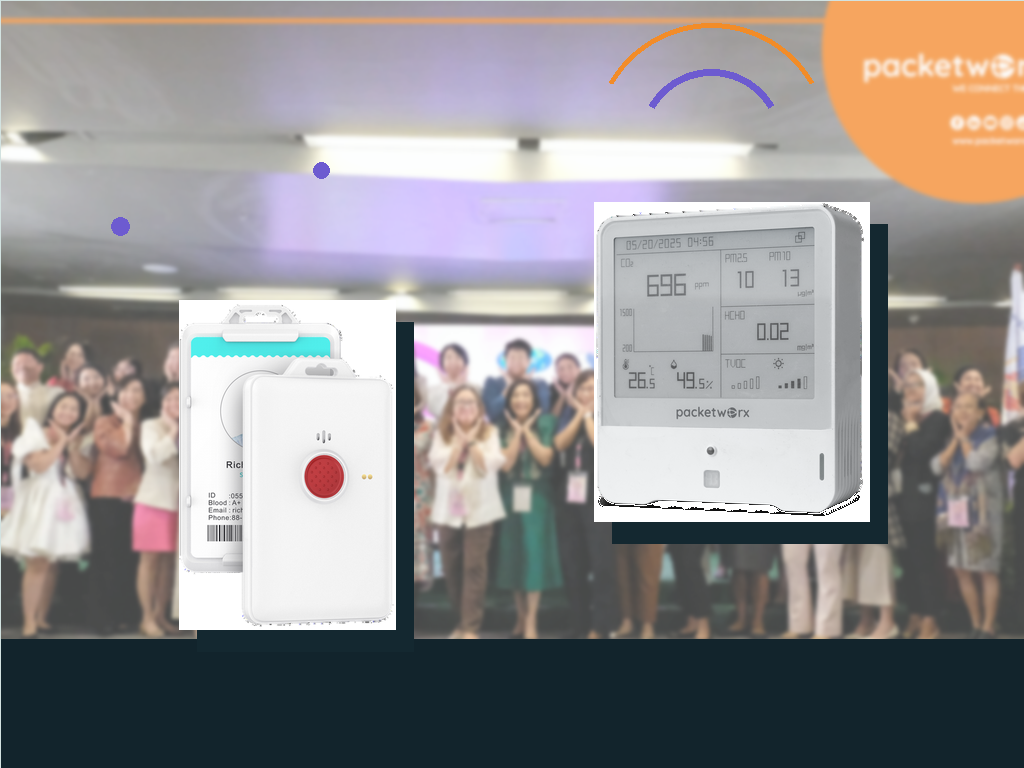
ICCT Participates in Experiential Learning at the Hub: Deployment and Solution Perspective
IoT enablement depends on skills, partner readiness, student pathways, and a clear route from prototype to pilot deployment.
Executive Brief
- Focus area: Education, talent, and ecosystem enablement.
- Connectivity model: low-power distributed sensing over LoRaWAN, supported by gateways, device management, dashboards, alerts, and integration-ready data.
- Solution fit: combine connectivity, packetSENSE devices, packetCELL gateways, packetVIEW, and partner enablement into a phased deployment.
- Implementation principle: start with measurable operational decisions, not with isolated devices.
The Campus IoT Learning-to-Deployment Problem
Schools and universities need more than IoT lectures; they need practical pathways where students handle sensors, gateways, dashboards, payloads, and real Philippine use cases. Campus enablement works when learning environments produce prototypes that can be evaluated as deployable solutions for buildings, agriculture, disaster readiness, utilities, and smart cities.
educational partners are highlighted in Packetworx community materials
Packetworx Community Initiativesinternship graduates are highlighted in Packetworx community materials
Packetworx Community InitiativesIoT learning is strongest when students work with live devices, dashboards, and field constraints
Packetworx IoT Technology HubPriority Use Cases
- Use packetduino, packetSENSE devices, LoRaWAN gateways, and packetVIEW dashboards in labs and campus workshops.
- Guide student teams from problem definition to sensor selection, payload review, dashboard design, and pilot planning.
- Connect campus projects to LGU, agriculture, building, utility, and resilience use cases that need local innovation.
Enablement Context
IoT adoption depends on people as much as devices. Schools, universities, system integrators, startups, LGUs, and enterprise teams need practical exposure to sensors, LoRaWAN coverage, dashboard design, data interpretation, and deployment discipline. Education programs, hackathons, internships, and developer kits turn abstract interest into working prototypes and deployable use cases.
Reference Architecture
- Sensing layer: low-power devices capture physical signals such as air quality, water level, rainfall, energy, motion, temperature, humidity, equipment status, location, or user feedback.
- Connectivity layer: LoRaWAN carries small telemetry messages over long distances to packetCELL gateways or compatible LoRaWAN infrastructure, with cellular or wired backhaul where needed.
- Network and platform layer: the LoRaWAN Network Server, packetVIEW, and partner platforms manage device identity, payload decoding, dashboards, alerts, reports, and APIs.
- Operations layer: facility teams, LGUs, campuses, integrators, or enterprise users act on exceptions, compare trends, and refine thresholds based on actual field behavior.
Packetworx Solution Stack
This use case can be implemented as a layered solution rather than a one-off installation. Relevant Packetworx building blocks include:
- packetduino, developer kits, and lab-ready devices for student and partner prototyping
- packetSENSE environmental, utility, occupancy, and tracker devices for hands-on use-case development
- packetCELL gateways and LoRaWAN network access for practical connectivity exercises
- packetVIEW dashboards for teaching data visualization, thresholds, alerts, and reporting
- Mentored programs such as Campus IoT Tour, IoT Technology Hub, internships, packetHACKS, and IoTCon activities
Deployment Blueprint
- Define the operating decision first: alerting, reporting, compliance evidence, maintenance triage, resource optimization, or public-service coordination.
- Map the physical environment: sensor locations, mounting constraints, gateway placement, backhaul, power source, and field-service access.
- Select the sensing and integration stack: LoRaWAN devices, packetCELL gateways, packetMODBUS where legacy equipment is involved, packetVIEW dashboards, and APIs where the data must feed an existing platform.
- Set data rules before rollout: sampling interval, alert thresholds, escalation owner, historical reporting cadence, and exception-handling workflow.
- Pilot in a bounded area, review data quality and user behavior, then expand by repeating the same deployment pattern across sites, departments, campuses, or LGU locations.
Operational Metrics to Track
A successful rollout should define success measures before devices are installed. Useful metrics for this topic include:
- number of trained students or partners
- working prototypes completed
- campus or LGU pilots launched
- mentor-review cycles
- projects moving from demo to deployment
Governance, Security, and Integration
LoRaWAN deployments should be treated as operational technology, not casual gadget projects. Device identity, gateway ownership, alert permissions, dashboard access, data retention, and API use must be clear before scale-up. For schools, LGUs, utilities, and enterprises, the same discipline also improves procurement: each phase can be tied to coverage, device count, operating owner, service-level expectation, and a measurable outcome.
Background Reading
Manila, Philippines. Last March 13, The Institute of Creative Computer Technology (ICCT) visited Packetworx's IoT Technology Hub. The visit was to get a hands-on experience on the different learning facilities that the Hub offers.
The Institute of Creative Computer Technology from Cainta, Rizal during their visit at the Hub.
Packetworx is a social enterprise that promotes the Internet of Things (IoT) in the Philippines. It focuses on providing universities and schools with different IoT tools and resources. It strives to help them by offering free tours and learning sessions about IoT. When visiting the Hub, students can share their innovative ideas. With the Hub’s free resources, they can turn these ideas into reality.
The main goal of Packetworx's initiatives is to make the Philippines globally competitive. This is by educating and equipping innovators with top-of-the-line IoT learning experience.
Aside from free visits to the IoT Technology Hub, Packetworx also conducts Campus IoT Tours. It also facilitates the IoT Learning Program with free LoRaWAN Academy and free hardware developer kits.
Packetworx's Marketing and Communications Head Raisa Ysaac-Orbon shares inspiring innovation stories during ICCT’s tour.
‘We are encouraging the students to visit the IoT Technology Hub and explore how they can make ideas happen here. The creativity of the students goes beyond classrooms. The best way to empower these young minds is through experiential learning.’ Shared Raisa Ysaac-Orbon, Marketing and Communications Head of Packetworx.