
Internet of Things: Is the Philippines Ready for IoT?: Deployment and Solution Perspective
The technical value of LoRaWAN is strongest when it is combined with coverage strategy, device interoperability, partner enablement, hosted platforms, and repeatable deployment patterns.
Executive Brief
- Focus area: LoRaWAN network, partnerships, and IoT market adoption.
- Connectivity model: low-power distributed sensing over LoRaWAN, supported by gateways, device management, dashboards, alerts, and integration-ready data.
- Solution fit: combine connectivity, packetSENSE devices, packetCELL gateways, packetVIEW, and partner enablement into a phased deployment.
- Implementation principle: start with measurable operational decisions, not with isolated devices.
The IoT Readiness Problem
Being ready for IoT means more than knowing the technology exists. Organizations need a real problem, device strategy, network plan, data owner, budget model, security posture, and operating workflow before sensors can deliver value.
LoRaWAN base stations were included in Packetworx and Actility's nationwide deployment plan
ActilityLoRaWAN use cases span cities, buildings, utilities, agriculture, logistics, and industry
LoRa AllianceIoT programs reduce risk when they begin with measurable decisions and expand after pilot validation
Packetworx FAQPriority Use Cases
- Start with one measurable decision such as leak response, classroom IAQ, utility loss, equipment uptime, flood monitoring, or energy accountability.
- Validate coverage, battery life, dashboard behavior, alert ownership, and field support during a bounded pilot.
- Scale only after users know which readings matter and how those readings change action.
LoRaWAN Adoption Context
LoRaWAN fits IoT workloads that need long range, low power, wide-area coverage, and modest payloads from many distributed sensors. For the Philippine market, the strategic issue is not simply whether sensors can transmit; it is whether enterprises, LGUs, schools, telcos, and integrators can build reliable programs on top of connectivity, gateways, device management, dashboards, and support.
Reference Architecture
- Sensing layer: low-power devices capture physical signals such as air quality, water level, rainfall, energy, motion, temperature, humidity, equipment status, location, or user feedback.
- Connectivity layer: LoRaWAN carries small telemetry messages over long distances to packetCELL gateways or compatible LoRaWAN infrastructure, with cellular or wired backhaul where needed.
- Network and platform layer: the LoRaWAN Network Server, packetVIEW, and partner platforms manage device identity, payload decoding, dashboards, alerts, reports, and APIs.
- Operations layer: facility teams, LGUs, campuses, integrators, or enterprise users act on exceptions, compare trends, and refine thresholds based on actual field behavior.
Packetworx Solution Stack
This use case can be implemented as a layered solution rather than a one-off installation. Relevant Packetworx building blocks include:
- packetCELL Outdoor LoRaWAN Gateway for field, campus, city, and industrial coverage
- LoRaWAN Network Server and packetVIEW for device onboarding, routing, dashboards, and alerts
- packetMODBUS for connecting industrial and utility equipment that already speaks Modbus
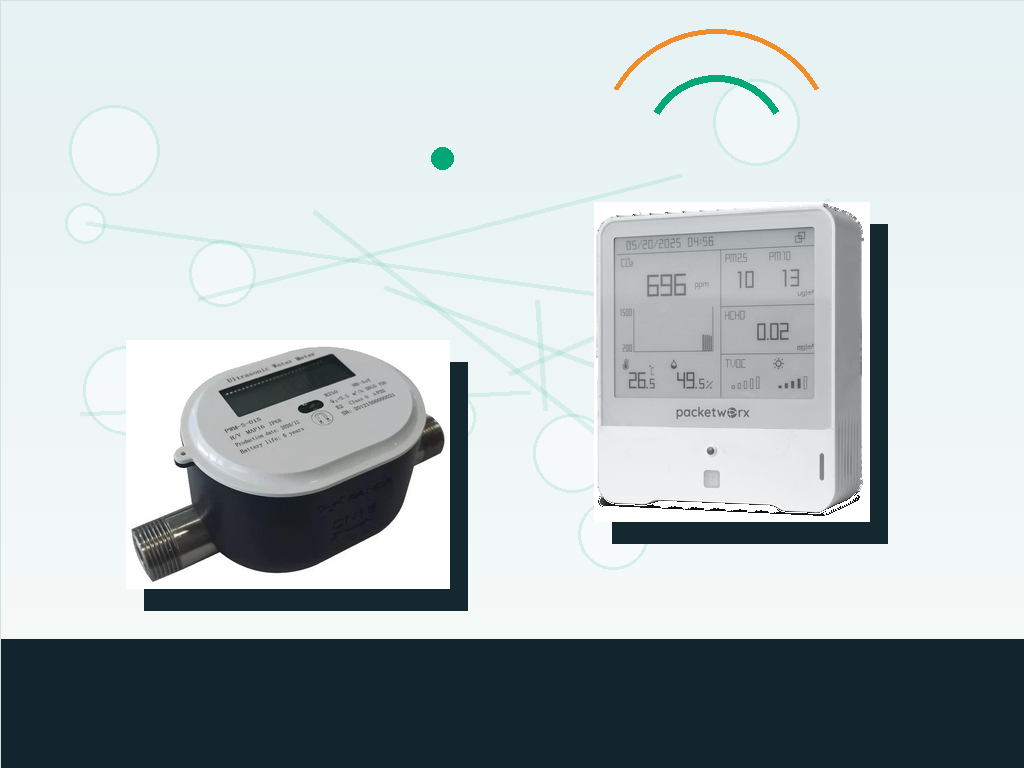
- packetSENSE devices across air quality, weather, water, power, motion, tracking, and safety use cases
- Partner integrations through REST APIs, system integrators, telcos, universities, and solution providers
Deployment Blueprint
- Define the operating decision first: alerting, reporting, compliance evidence, maintenance triage, resource optimization, or public-service coordination.
- Map the physical environment: sensor locations, mounting constraints, gateway placement, backhaul, power source, and field-service access.
- Select the sensing and integration stack: LoRaWAN devices, packetCELL gateways, packetMODBUS where legacy equipment is involved, packetVIEW dashboards, and APIs where the data must feed an existing platform.
- Set data rules before rollout: sampling interval, alert thresholds, escalation owner, historical reporting cadence, and exception-handling workflow.
- Pilot in a bounded area, review data quality and user behavior, then expand by repeating the same deployment pattern across sites, departments, campuses, or LGU locations.
Operational Metrics to Track
A successful rollout should define success measures before devices are installed. Useful metrics for this topic include:
- gateway availability
- device join success
- message delivery consistency
- battery replacement interval
- pilot-to-rollout conversion
Governance, Security, and Integration
LoRaWAN deployments should be treated as operational technology, not casual gadget projects. Device identity, gateway ownership, alert permissions, dashboard access, data retention, and API use must be clear before scale-up. For schools, LGUs, utilities, and enterprises, the same discipline also improves procurement: each phase can be tied to coverage, device count, operating owner, service-level expectation, and a measurable outcome.
Background Reading
The Philippines is adopting the Internet of Things (IoT) and making it an important ingredient of a smarter digital future for the country.
The IoT has its roots in the late 20th century when the concept of connecting physical objects to the internet began to emerge. Coined by British technology pioneer Kevin Ashton in 1999, Internet of Things envisioned a future where objects with sensors could be embedded and seamlessly communicate with each other.
It was in the early 2000s that significant advancements in wireless communication and sensor technologies paved the way for practical IoT applications. The evolution of technology enabled object identification and tracking, revolutionizing supply chain management and inventory control systems. As internet connectivity became more efficient and affordable, the IoT steadily gained momentum. By the 2010s, IoT applications started multiplying across various sectors that included smart homes, agriculture, healthcare and manufacturing.
The Internet of Things is in the Philippines. At present, this technology is still in the evolution stage but, with proper planning and execution, it offers a game-changing prospect of proliferation on the horizon. During the global coronavirus disease 2019 (Covid-19) pandemic, IoT adoption accelerated and expanded for utility companies in power and water. Local government units (LGUs) employed and deployed IoT solutions for smart city applications and in smart building operations. For IoT to assume a larger role and reach, both government and private sectors must work in tandem.
The private sector must take an active role in continuing to bring IoT to the country. Companies specializing in IoT solutions and services have entered the market, collaborating with various industries to implement IoT applications. These collaborations have enabled sectors such as agriculture, manufacturing, transportation and utilities to leverage IoT technologies for improved efficiency, productivity and decision-making. There should also be efforts to work with educational institutions to raise awareness and provide programs through seminars, workshops and training sessions to equip individuals and businesses with the knowledge and skills required to harness the full potential of IoT.
Meanwhile, government efforts and policies should promote and support the development of IoT in the Philippines. Toward this end, the Department of Information and Communications Technology (DICT), under the leadership of Secretary Ivan John Uy, has been actively involved in formulating strategies and guidelines to encourage IoT adoption. The initiatives focus on creating an enabling environment for IoT development, fostering innovation and supporting local IoT startups.
DICT Undersecretary Jocelle Batapa-Sigue believes the Internet of Things has a significant role in the digital transformation journey of the Philippines that will lead to numerous benefits and advancements across a large area.
“I believe that when we focus on how we can harness IoT and really leverage the use of this technology to improve our systems alongside other emerging technologies, we can greatly contribute to the journey of this country toward digital transformation,” she said.
In 2012, Batapa-Sigue was an Eisenhower Fellow for ICT, ICT Startups, Animation and Game Development and Health Care Information Management. During her month-long stay in the United States, Batapa-Sigue said she witnessed firsthand what IoT could accomplish - from the home to health care. She returned to the Philippines convinced that loT could serve as a catalyst for her nation’s digital transformation journey.
“IoT empowers industries and sectors to leverage data and connectivity to drive innovation, efficiency and economic growth. It opens up new possibilities for businesses, improves services for citizens and helps build a more digitally connected and advanced nation,” she explained.
The future DICT undersecretary had the opportunity to see firsthand what tech firms in Silicon Valley and companies such as Microsoft were developing. She recalled that while Big Data and artificial intelligence (AI) were absent from the conversation at that time, IoT was already visible in many working applications.
“I asked myself, why was IoT at the tailend (in the Philippines)? We could have brought this together with everything and made things easier for other technologies such as Big Data. It was a ‘Eureka!’ moment for me when I realized that nobody was taking care of the hardware. It was all software. (Greater emphasis on IoT) would have made our lives easier. IoT is one of the missing pieces for us to bring Filipino products and services to an industrial level,” Batapa-Sigue pointed out.
As she surveys the current ecosystem in her role at DICT, the former city councilor from Bacolod City said she was “very happy” that she found herself in the “middle of all of these things” and was able to share encouraging initiatives already employing IoT in both private and public sectors.
Batapa-Sigue said, “In agriculture, we are seeing devices such as sensors and actuators that monitor soil moisture, temperature, humidity levels that enable farmers to make data-driven decisions for irrigation, pest control and crop management. This leads to productivity, reduces cost and optimizes resource utilization in the agricultural sector. I would love to see more of these things happen.
“I have met civil society organizations and social enterprises that are already moving in the space. What they are asking from me is to connect them with the academe - there has to be an interplay between them for the sustainability of this technology. LGU participation is important to help farmers in various locations.”
“IoT has been instrumental in enhancing efficiency, safety and sustainability of current initiatives in our country. Soon enough we will have more connected devices and systems that will allow us real time monitoring of traffic conditions, vehicle tracking and predictive maintenance. IoT will allow the country to have better traffic management, smoother logistic operations and improved road safety.
“As part of national government, I would be more interested in how these technologies translate to outcomes rather than in the technology itself. Building technology is not the outcome. The outcome is how these technologies actually benefit the user,” she added.
“We have examples in the Philippines of enabling remote patient monitoring, wearable health devices and smart medical equipment. These IoT-enabled solutions enhance healthcare access. They enable early detection of health issues, improve patient care by providing real time health data for healthcare professionals,” the DICT official said.
While in the US in 2012, Batapa-Sigue discovered that Health Information Technology (HIT) was primarily about IoT. Semi-robotic machines were deployed to remote areas to address healthcare needs such as taking the temperature, heartbeat and other vital signs of patients, with the data then transmitted to a central location in Texas for interpretation by human doctors and specialists.
She recalled, “What struck me most was this very targeted program of a couple of universities that were implementing what was called a ‘Health IT course’. I asked the administrator whether this was a health course or an IT course. He said it was neither. It was a Health IT course, a specialized course. If we roll out IoT and leverage this technology (in the Philippines), we need to create and design courses - courses that will embed IoT into health or into agriculture because these are specialized (in nature). In this day and age you cannot be a generalist, you have to be a specialist.”
Smart cities are already starting to build systems, connected devices, sensors and data analytics that are being used to optimize energy consumption, manage waste, enhance public safety and improve urban planning. Where will these lead to? Sustainable and efficient cities that make lives better for their residents. Smart cities exist for the interests of their residents. Many government units now use IoT. There are many municipalities using IoT to prevent casualties from floods by using sensors and devices to monitor and provide early warning.
“loT is identified as a catalyst for the digital transformation journey in the Philippines, empowering industries and sectors to leverage data and connectivity to drive innovation, efficiency and economic growth. IoT has opened up new possibilities for businesses, improved services for citizens, and helped in building a more digitally connected and advanced nation,” the DICT official said.
Batapa-Sigue said DICT had already launched a number of initiatives to help promote IoT adoption on a larger scale.
As supervising undersecretary for the ICT Industry Development Bureau (IIDB) of the DICT, Batapa-Sigue oversees a number of programs. The IIDB is mandated to help fulfill DICT’s mission of ensuring sustainable growth of Philippine ICT-enabled industries for the creation of more jobs. Its policies and framework span the ICT Industry, which covers Creative Industry, IT-BPM Industry, Online Freelancing Industry, Startups and Emerging Technologies.