
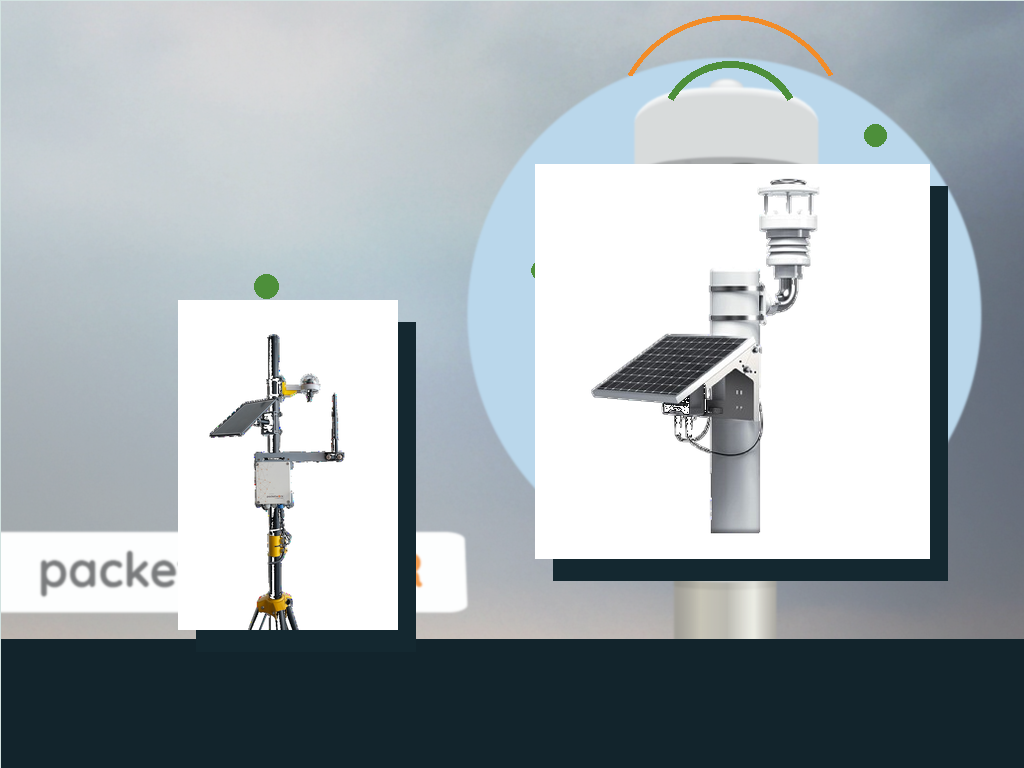
Packetworx Collaborates With WSI to Engage Weather-Sensing Capabilities: Deployment and Solution Perspective
Climate and field intelligence becomes practical when field readings are connected to farm decisions, LGU resilience, water-resource planning, and risk reduction.
Executive Brief
- Focus area: Agriculture, weather, and environmental monitoring.
- Connectivity model: low-power distributed sensing over LoRaWAN, supported by gateways, device management, dashboards, alerts, and integration-ready data.
- Solution fit: combine connectivity, packetSENSE devices, packetCELL gateways, packetVIEW, and partner enablement into a phased deployment.
- Implementation principle: start with measurable operational decisions, not with isolated devices.
The Local Weather Data Gap
National and regional weather information is essential, but agriculture and resilience teams often need measurements closer to the farm, watershed, school, or barangay where action is taken. Weather-station partnerships help create local context for rainfall, wind, temperature, humidity, radiation, and pressure patterns that influence crop risk, flood readiness, and field operations.
tropical cyclones enter the Philippine Area of Responsibility on average
PAGASAtropical cyclones cross the Philippines on average each year
PAGASAsite-level weather readings help convert broad forecasts into operational decisions for farms, LGUs, and campuses
Packetworx weather-sensing use casePriority Use Cases
- Install weather stations in agricultural areas, campuses, and LGU sites where local conditions differ from regional averages.
- Feed rainfall, wind, temperature, humidity, and pressure trends into farm advisories and disaster-readiness dashboards.
- Use historical station data for seasonal planning, climate adaptation, and post-event analysis.
Field and Climate Context
Philippine agriculture is exposed to highly variable rainfall, heat, wind, flooding, drought, and water-quality conditions. A resilient agriculture program needs more than periodic inspection; it needs distributed sensing that can stay in the field, operate on low power, and report conditions often enough to influence irrigation, planting, crop protection, aquaculture, and disaster-readiness decisions.
Reference Architecture
- Sensing layer: low-power devices capture physical signals such as air quality, water level, rainfall, energy, motion, temperature, humidity, equipment status, location, or user feedback.
- Connectivity layer: LoRaWAN carries small telemetry messages over long distances to packetCELL gateways or compatible LoRaWAN infrastructure, with cellular or wired backhaul where needed.
- Network and platform layer: the LoRaWAN Network Server, packetVIEW, and partner platforms manage device identity, payload decoding, dashboards, alerts, reports, and APIs.
- Operations layer: facility teams, LGUs, campuses, integrators, or enterprise users act on exceptions, compare trends, and refine thresholds based on actual field behavior.
Packetworx Solution Stack
This use case can be implemented as a layered solution rather than a one-off installation. Relevant Packetworx building blocks include:
- packetSENSE Automated Weather Station for wind, rainfall, radiation, pressure, temperature, and humidity context
- packetSENSE Rainfall and Submersible Hydrostatic Pressure Level for flood, watershed, and drainage monitoring
- packetSOIL and soil-moisture sensing for irrigation timing and crop-condition programs
- packetSENSE AquaMetrics Pro and AquaScope for water quality, aquaculture, reservoirs, and environmental programs
- packetSENSE Outdoor Air Quality with Solar Panel for climate, emissions, and public-environment monitoring
Deployment Blueprint
- Define the operating decision first: alerting, reporting, compliance evidence, maintenance triage, resource optimization, or public-service coordination.
- Map the physical environment: sensor locations, mounting constraints, gateway placement, backhaul, power source, and field-service access.
- Select the sensing and integration stack: LoRaWAN devices, packetCELL gateways, packetMODBUS where legacy equipment is involved, packetVIEW dashboards, and APIs where the data must feed an existing platform.
- Set data rules before rollout: sampling interval, alert thresholds, escalation owner, historical reporting cadence, and exception-handling workflow.
- Pilot in a bounded area, review data quality and user behavior, then expand by repeating the same deployment pattern across sites, departments, campuses, or LGU locations.
Operational Metrics to Track
A successful rollout should define success measures before devices are installed. Useful metrics for this topic include:
- rainfall intensity and accumulation
- soil moisture trend
- irrigation response time
- water quality exceptions
- localized weather anomalies
Governance, Security, and Integration
LoRaWAN deployments should be treated as operational technology, not casual gadget projects. Device identity, gateway ownership, alert permissions, dashboard access, data retention, and API use must be clear before scale-up. For schools, LGUs, utilities, and enterprises, the same discipline also improves procurement: each phase can be tied to coverage, device count, operating owner, service-level expectation, and a measurable outcome.
Background Reading
Following the number of various climate changes phenomena in the Philippines, the Weather Solutions, Inc. (WSI) partnered with Packetworx to provide weather solutions and improve WSI’s weather data collection.
Packetworx's IoT Solution will enhance WSI’s capabilities of providing accurate weather data as such will help communities and businesses to be weather-responsive.
WSI is engaged in the business of providing Philippine weather information, weather analytics, weather consultancy services and other weather-related services, and has been engaged by Weather Philippines Foundation, Inc. (WPF) to, among others, manage and maintain WPF’s Automated Weather Stations (AWS).
‘With the partnership, Packetworx extends WSI’s weather-sensing capabilities to 15km radius from is AWS using cost-effective weather sensors. This enables WSI to provide even more granularity compared to its already impressive localized weather information from its over 800 AWS stations across the Philippines,’ says Arnold Bagabaldo, Founder and CEO of Packetworx.
Packetworx's lightning sensor device detects the presence and approach of potentially hazardous lightning activity in the vicinity and provides estimation on the distance to the head of the storm. The embedded lightning algorithm checks the incoming signal pattern to reject the potential man-made disturbers.
IoT is the concept of connecting any device to the Internet and to the other connected devices. It is a network of things that sends, receives and collects information. With this technology, businesses can make better decisions and mitigate risks with more accurate weather analytics.
Packetworx is a technology social enterprise which focuses on enabling IoT in the Philippines. It is a member of the LoRa Alliance™, a worldwide alliance of over 500-member companies that support the standardization of LPWAN with the LoRaWAN specification and has created a certification and compliance program to ensure interoperability among its members.
It is the official host of the regional LoRaWAN network for the Philippines and Southeast Asia through its partnership with The Things Network (TTN), the largest community of startups, businesses and developers globally building a public IoT data network.
Weather Solutions, Inc. is a social enterprise that has been incorporated by the Aboitiz group. The main objective of the company is to use the infrastructure that the Weather Philippines Foundation has created. WSI make commercial arrangements with different verticals and supports the Foundation’s advocacy and activities.