
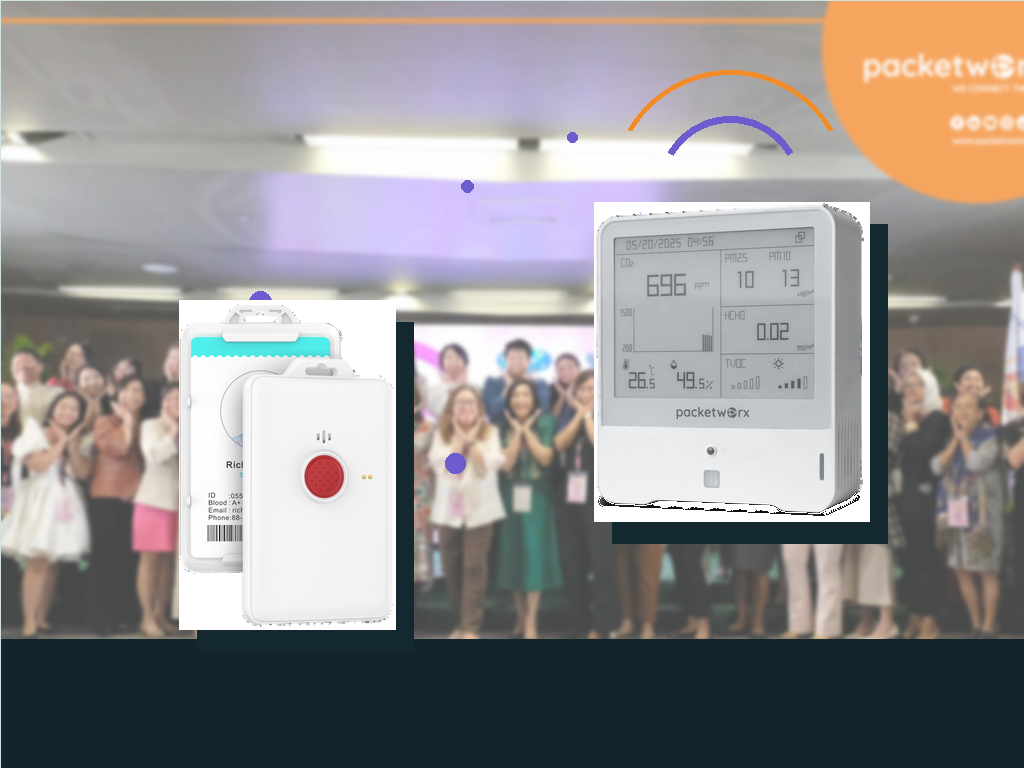
Packetworx Joins JRU to Its 1st ICT Congress: Deployment and Solution Perspective
IoT enablement depends on skills, partner readiness, student pathways, and a clear route from prototype to pilot deployment.
Executive Brief
- Focus area: Education, talent, and ecosystem enablement.
- Connectivity model: low-power distributed sensing over LoRaWAN, supported by gateways, device management, dashboards, alerts, and integration-ready data.
- Solution fit: combine connectivity, packetSENSE devices, packetCELL gateways, packetVIEW, and partner enablement into a phased deployment.
- Implementation principle: start with measurable operational decisions, not with isolated devices.
The Campus IoT Learning-to-Deployment Problem
Schools and universities need more than IoT lectures; they need practical pathways where students handle sensors, gateways, dashboards, payloads, and real Philippine use cases. Campus enablement works when learning environments produce prototypes that can be evaluated as deployable solutions for buildings, agriculture, disaster readiness, utilities, and smart cities.
educational partners are highlighted in Packetworx community materials
Packetworx Community Initiativesinternship graduates are highlighted in Packetworx community materials
Packetworx Community InitiativesIoT learning is strongest when students work with live devices, dashboards, and field constraints
Packetworx IoT Technology HubPriority Use Cases
- Use packetduino, packetSENSE devices, LoRaWAN gateways, and packetVIEW dashboards in labs and campus workshops.
- Guide student teams from problem definition to sensor selection, payload review, dashboard design, and pilot planning.
- Connect campus projects to LGU, agriculture, building, utility, and resilience use cases that need local innovation.
Enablement Context
IoT adoption depends on people as much as devices. Schools, universities, system integrators, startups, LGUs, and enterprise teams need practical exposure to sensors, LoRaWAN coverage, dashboard design, data interpretation, and deployment discipline. Education programs, hackathons, internships, and developer kits turn abstract interest into working prototypes and deployable use cases.
Reference Architecture
- Sensing layer: low-power devices capture physical signals such as air quality, water level, rainfall, energy, motion, temperature, humidity, equipment status, location, or user feedback.
- Connectivity layer: LoRaWAN carries small telemetry messages over long distances to packetCELL gateways or compatible LoRaWAN infrastructure, with cellular or wired backhaul where needed.
- Network and platform layer: the LoRaWAN Network Server, packetVIEW, and partner platforms manage device identity, payload decoding, dashboards, alerts, reports, and APIs.
- Operations layer: facility teams, LGUs, campuses, integrators, or enterprise users act on exceptions, compare trends, and refine thresholds based on actual field behavior.
Packetworx Solution Stack
This use case can be implemented as a layered solution rather than a one-off installation. Relevant Packetworx building blocks include:
- packetduino, developer kits, and lab-ready devices for student and partner prototyping
- packetSENSE environmental, utility, occupancy, and tracker devices for hands-on use-case development
- packetCELL gateways and LoRaWAN network access for practical connectivity exercises
- packetVIEW dashboards for teaching data visualization, thresholds, alerts, and reporting
- Mentored programs such as Campus IoT Tour, IoT Technology Hub, internships, packetHACKS, and IoTCon activities
Deployment Blueprint
- Define the operating decision first: alerting, reporting, compliance evidence, maintenance triage, resource optimization, or public-service coordination.
- Map the physical environment: sensor locations, mounting constraints, gateway placement, backhaul, power source, and field-service access.
- Select the sensing and integration stack: LoRaWAN devices, packetCELL gateways, packetMODBUS where legacy equipment is involved, packetVIEW dashboards, and APIs where the data must feed an existing platform.
- Set data rules before rollout: sampling interval, alert thresholds, escalation owner, historical reporting cadence, and exception-handling workflow.
- Pilot in a bounded area, review data quality and user behavior, then expand by repeating the same deployment pattern across sites, departments, campuses, or LGU locations.
Operational Metrics to Track
A successful rollout should define success measures before devices are installed. Useful metrics for this topic include:
- number of trained students or partners
- working prototypes completed
- campus or LGU pilots launched
- mentor-review cycles
- projects moving from demo to deployment
Governance, Security, and Integration
LoRaWAN deployments should be treated as operational technology, not casual gadget projects. Device identity, gateway ownership, alert permissions, dashboard access, data retention, and API use must be clear before scale-up. For schools, LGUs, utilities, and enterprises, the same discipline also improves procurement: each phase can be tied to coverage, device count, operating owner, service-level expectation, and a measurable outcome.
Background Reading
Packetworx Campus IoT Tour’s mission to accelerate the adoption of Internet of Things in the Philippines has led the team in Jose Rizal University last October 2, 2018. Packetworx was invited to JRU’s 1st IT Congress Senior High School Edition with the event theme ‘Shaping the World through ICT innovation.’ Around 200 Grade 11 ICT and Animation students joined the seminar.
Marketing and Communications Head Raisa Orbon and Lead Hardware Design Engineer Carl Rowan introduced the concept and IoT ecosystem to the students. They also discussed the LoRa and LoRaWAN connectivity, devices, usage, and benefits of IoT technology.
‘Opening the IoT Technology Hub to Senior High School students creates chances for these young learners to explore and experiment different devices. We are here to share our IoT expertise and resources with the students and professors. It is our mission to involve the next generation in the fast-paced developments of IoT,’ says Orbon.
JRU students understand that the IoT is the biggest technology revolution not only in the Philippines but also around the world. It is said that IoT will transform the country’s businesses and individuals into an IoT-powered community.
‘The discussion definitely gave a better understanding for us students on things such as the Internet of Things and different gadgets that could help not only the students but also the community. As the representative of the student body, I’m very grateful to have the opportunity to learn new things from Packetworx's amazing team,’ Miggle Abanto, Grade 12 Computer System Servicing (CSS) student of Jose Rizal University.
‘We are looking forward on how Packetworx could better help the country with their different devices. With those devices more people would have access and jump start their interest on creating more things that could be a great use for everyone,’ Abanto added.
Packetworx believes that in order to achieve their goals, the local academe plays an important role by including the IoT subject in the curriculum and having the students equipped with necessary devices where they can create and develop their own sensors and applications. These tools are also provided to schools and universities by Packetworx for free.
‘We’d like to thank Packetworx. Their talk is an opportunity to share the IoT knowledge to our students, most especially to Grade 11 who will be introduced to hardware and software. We are also looking forward to invite Packetworx again for a seminar dedicated to Grade 12 students. It is important for us to learn the future if IoT and how it will affect the next generation,’ says Ms. Leila Roxas, Department Chair of TechVoc Special Subjects.
Packetworx is a technology social enterprise which focuses on enabling IoT in the Philippines. It is a member of the LoRa Alliance™, a worldwide alliance of over 500-member companies that support the standardization of LPWAN with the LoRaWAN specification and has created a certification and compliance program to ensure interoperability among its members.
It is the official host of the regional LoRaWAN network for the Philippines and Southeast Asia through its partnership with The Things Network (TTN), the largest community of startups, businesses and developers globally building a public IoT data network.