
Packetworx Makes Safe Reopening of Schools Possible: Deployment and Solution Perspective
A building-intelligence program identifies the operating conditions that matter, connects the right sensor points, and converts facility signals into response, reporting, and long-term performance improvement.
Executive Brief
- Focus area: Facilities and building operations.
- Connectivity model: low-power distributed sensing over LoRaWAN, supported by gateways, device management, dashboards, alerts, and integration-ready data.
- Solution fit: combine connectivity, packetSENSE devices, packetCELL gateways, packetVIEW, and partner enablement into a phased deployment.
- Implementation principle: start with measurable operational decisions, not with isolated devices.
The Classroom Health and Heat-Readiness Problem
Schools and classrooms have a different operating risk profile from office buildings. Administrators must protect students and teachers in crowded rooms where ventilation, heat, humidity, and occupancy can affect comfort, attendance, and learning continuity. IoT for school reopening and school operations should therefore prioritize classroom air quality, temperature, humidity, heat-index awareness, and facility alerts that help leaders act before conditions become disruptive.
higher indoor pollutant levels can occur indoors than outdoors; students and teachers spend long periods inside classrooms
US EPA Schoolshigher cognitive scores were observed in green and enhanced-ventilation building conditions versus conventional conditions
Harvard / PubMedstudents globally had schooling disrupted by climate events in 2024, including heatwaves
UNICEFPriority Use Cases
- Monitor classroom CO2, particulate matter, temperature, humidity, and VOCs to guide ventilation and room-use decisions.
- Add temperature, humidity, weather, and heat-index-aware reporting for campuses exposed to hot weather and class-suspension risk.
- Use leak, smoke, motion, door, and feedback devices to support safer reopening, quicker facility response, and better campus operations.
Building IoT Context
Buildings are dense operating environments. Air quality, occupancy, energy use, water leaks, access events, and equipment health change continuously, but many teams still discover issues through complaints, manual rounds, or monthly utility reports. LoRaWAN is useful in this setting because it supports low-power sensors across floors, rooms, risers, utility spaces, and distributed campuses without forcing every device onto Wi-Fi.
Reference Architecture
- Sensing layer: low-power devices capture physical signals such as air quality, water level, rainfall, energy, motion, temperature, humidity, equipment status, location, or user feedback.
- Connectivity layer: LoRaWAN carries small telemetry messages over long distances to packetCELL gateways or compatible LoRaWAN infrastructure, with cellular or wired backhaul where needed.
- Network and platform layer: the LoRaWAN Network Server, packetVIEW, and partner platforms manage device identity, payload decoding, dashboards, alerts, reports, and APIs.
- Operations layer: facility teams, LGUs, campuses, integrators, or enterprise users act on exceptions, compare trends, and refine thresholds based on actual field behavior.
Packetworx Solution Stack
This use case can be implemented as a layered solution rather than a one-off installation. Relevant Packetworx building blocks include:
- packetSENSE Indoor Air Quality for CO2, particulate matter, temperature, humidity, VOC, and comfort monitoring
- packetSENSE Leak Detection for tanks, pantries, restrooms, server rooms, HVAC drains, and utility spaces
- packetSENSE AC Energy Meter with packetMODBUS for electrical consumption and power-quality visibility
- packetSENSE PIR Motion Sensor and Indoor Temperature and Humidity with PIR for occupancy-aware facility operations
- packetSENSE Smoke, Smart Door Lock, Feedback Button, and SubZero for safety, access, service, and cold-chain rooms
Deployment Blueprint
- Define the operating decision first: alerting, reporting, compliance evidence, maintenance triage, resource optimization, or public-service coordination.
- Map the physical environment: sensor locations, mounting constraints, gateway placement, backhaul, power source, and field-service access.
- Select the sensing and integration stack: LoRaWAN devices, packetCELL gateways, packetMODBUS where legacy equipment is involved, packetVIEW dashboards, and APIs where the data must feed an existing platform.
- Set data rules before rollout: sampling interval, alert thresholds, escalation owner, historical reporting cadence, and exception-handling workflow.
- Pilot in a bounded area, review data quality and user behavior, then expand by repeating the same deployment pattern across sites, departments, campuses, or LGU locations.
Operational Metrics to Track
A successful rollout should define success measures before devices are installed. Useful metrics for this topic include:
- air-quality threshold events
- energy consumption by site or zone
- water-leak response time
- occupancy by room or floor
- maintenance tickets avoided or shortened
Governance, Security, and Integration
LoRaWAN deployments should be treated as operational technology, not casual gadget projects. Device identity, gateway ownership, alert permissions, dashboard access, data retention, and API use must be clear before scale-up. For schools, LGUs, utilities, and enterprises, the same discipline also improves procurement: each phase can be tied to coverage, device count, operating owner, service-level expectation, and a measurable outcome.
Background Reading
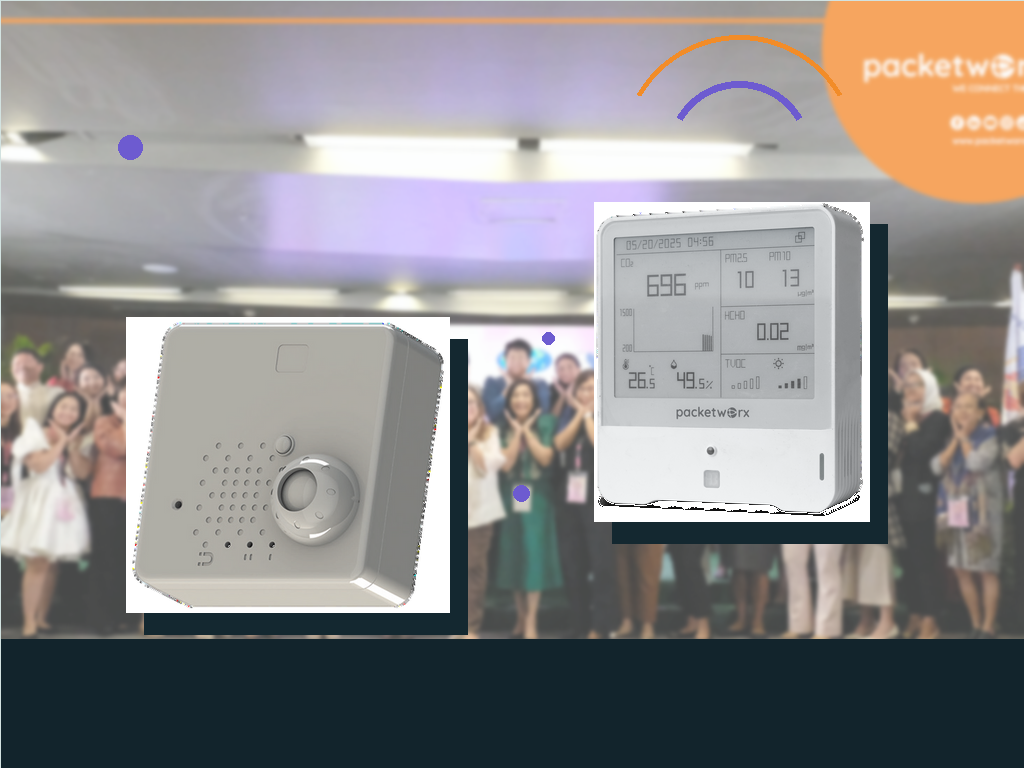
Packetworx is committed to designing and developing IoT solutions that do more than compete in the innovation landscape but also contribute to the improvement of the lives of Filipinos, especially those who need support the most. With the gradual return of schools to traditional face-to-face setup, it has become necessary to ensure that correct health and safety measures are in place. Packetworx developed and launched a solution that can do just that-the packetAIR, Indoor Air Quality Monitoring System.
This solution uses the power of the Internet of Things in fostering a safe and healthy learning environment for students and teachers in the ‘new normal’ of school setups. By investing in this air quality monitoring solution, parents and guardians can rest assured that children are protected against the COVID-19 virus while making the most of face-to-face learning.
What the packetAIR Does The packetAIR is an IoT solution that comes with nine sensors which provide real-time information on a space’s temperature and humidity, carbon dioxide level, volatile organic compounds (VOCs), and other relevant parameters. This capability is especially vital to ensuring an institution’s compliance with regulations set forth by the Department of Health.
The packetAIR aims to help schools address common problems associated with poor air quality. These include but are not limited to viral and chronic illnesses, decreased performance and productivity, discomfort, as well as absenteeism.
Moving Forward With the help of Packetworx, educational institutions can benefit from the power of the Internet of Things and use these innovations in improving the lives of their learners. In the future, more schools are expected to adopt this technology and discover the incredible benefits of automation to modern learning. Packetworx's straightforward platform and scalable, reliable technology will allow schools to meet the needs of students while ensuring peace of mind for their parents and guardians.
Packetworx is the leading enabler of IoT and the only IoT technology social enterprise in the Philippines. The company’s mission is to accelerate the adoption of IoT solutions to help the country transition toward an Internet-powered future. They do this by providing end-to-end IoT solutions, be it devices, network infrastructure, or cloud-based data visualization tools.