
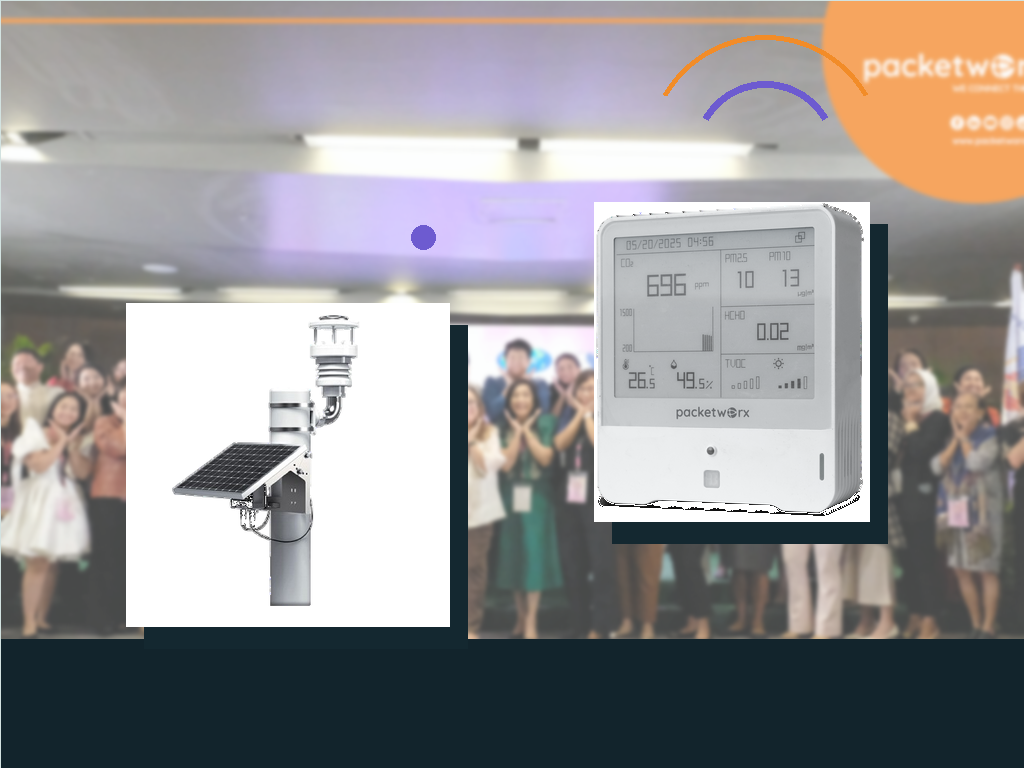
Packetworx to Launch the First LoRaWAN Academy Program in the Philippines: Deployment and Solution Perspective
IoT enablement depends on skills, partner readiness, student pathways, and a clear route from prototype to pilot deployment.
Executive Brief
- Focus area: Education, talent, and ecosystem enablement.
- Connectivity model: low-power distributed sensing over LoRaWAN, supported by gateways, device management, dashboards, alerts, and integration-ready data.
- Solution fit: combine connectivity, packetSENSE devices, packetCELL gateways, packetVIEW, and partner enablement into a phased deployment.
- Implementation principle: start with measurable operational decisions, not with isolated devices.
The IoT Skills-to-Curriculum Problem
IoT education becomes valuable when schools can move from awareness to repeatable instruction: devices, connectivity, dashboards, data interpretation, and deployment discipline. Curriculum programs should help teachers and students understand not only how sensors work, but how to turn field readings into useful decisions.
educational partners are highlighted in Packetworx community materials
Packetworx Community InitiativespacketHACKS x HackTheClimate 2025 participants were narrowed to 16 semi-finalist teams
IoT Conference PhilippinesIoT skills require experience with sensors, connectivity, data quality, and deployment workflows
Packetworx developer kitsPriority Use Cases
- Build course modules around environmental sensing, smart agriculture, disaster monitoring, utilities, and building operations.
- Use developer kits and live dashboards so students see payloads, thresholds, and reporting behavior.
- Connect classroom work to capstones, internships, hackathons, and partner-led pilots.
Enablement Context
IoT adoption depends on people as much as devices. Schools, universities, system integrators, startups, LGUs, and enterprise teams need practical exposure to sensors, LoRaWAN coverage, dashboard design, data interpretation, and deployment discipline. Education programs, hackathons, internships, and developer kits turn abstract interest into working prototypes and deployable use cases.
Reference Architecture
- Sensing layer: low-power devices capture physical signals such as air quality, water level, rainfall, energy, motion, temperature, humidity, equipment status, location, or user feedback.
- Connectivity layer: LoRaWAN carries small telemetry messages over long distances to packetCELL gateways or compatible LoRaWAN infrastructure, with cellular or wired backhaul where needed.
- Network and platform layer: the LoRaWAN Network Server, packetVIEW, and partner platforms manage device identity, payload decoding, dashboards, alerts, reports, and APIs.
- Operations layer: facility teams, LGUs, campuses, integrators, or enterprise users act on exceptions, compare trends, and refine thresholds based on actual field behavior.
Packetworx Solution Stack
This use case can be implemented as a layered solution rather than a one-off installation. Relevant Packetworx building blocks include:
- packetduino, developer kits, and lab-ready devices for student and partner prototyping
- packetSENSE environmental, utility, occupancy, and tracker devices for hands-on use-case development
- packetCELL gateways and LoRaWAN network access for practical connectivity exercises
- packetVIEW dashboards for teaching data visualization, thresholds, alerts, and reporting
- Mentored programs such as Campus IoT Tour, IoT Technology Hub, internships, packetHACKS, and IoTCon activities
Deployment Blueprint
- Define the operating decision first: alerting, reporting, compliance evidence, maintenance triage, resource optimization, or public-service coordination.
- Map the physical environment: sensor locations, mounting constraints, gateway placement, backhaul, power source, and field-service access.
- Select the sensing and integration stack: LoRaWAN devices, packetCELL gateways, packetMODBUS where legacy equipment is involved, packetVIEW dashboards, and APIs where the data must feed an existing platform.
- Set data rules before rollout: sampling interval, alert thresholds, escalation owner, historical reporting cadence, and exception-handling workflow.
- Pilot in a bounded area, review data quality and user behavior, then expand by repeating the same deployment pattern across sites, departments, campuses, or LGU locations.
Operational Metrics to Track
A successful rollout should define success measures before devices are installed. Useful metrics for this topic include:
- number of trained students or partners
- working prototypes completed
- campus or LGU pilots launched
- mentor-review cycles
- projects moving from demo to deployment
Governance, Security, and Integration
LoRaWAN deployments should be treated as operational technology, not casual gadget projects. Device identity, gateway ownership, alert permissions, dashboard access, data retention, and API use must be clear before scale-up. For schools, LGUs, utilities, and enterprises, the same discipline also improves procurement: each phase can be tied to coverage, device count, operating owner, service-level expectation, and a measurable outcome.
Background Reading
ORTIGAS CBD, PHILIPPINES Oct. 26, 2018 - LoRaWAN Academy, a comprehensive training regimen that gives developers a fundamental understanding of the LoRaWAN protocol and associated Internet of Things (IoT) technologies, has collaborated with Packetworx, a leading IoT company in the Philippines, for the launch of the first LoRaWANAcademy program in the Philippines.
‘Packetworx's goal is to build a future-ready Philippines. With the LoRaWAN Academy program and the support of its corporate sponsors, we will equip our next generation of innovators with the knowledge and skills to develop and operate IoT applications not just for the Philippines, but also globally,’ said Arnold Bagabaldo, CEO and Founder of Packetworx.
Packetworx is targeting 100 schools and educational institutions in 2018. The program provides university engineering programs with coursework, network equipment, kits, and necessary software to effectively teach students about LoRaWAN protocol-based low power wide area networks (LPWANs) and applications. Coursework is developed by LoRaWAN Academy’s corporate sponsors - companies within the LPWAN supply chain, each offering specific expertise regarding Semtech’s LoRa® devices and wireless radio frequency technology (LoRa Technology). The program curriculum consists of online classes, supplemental reading materials and hands-on assignments. Upon the program’s completion, students can apply their learnings by using the LoRaWAN hardware kits and network infrastructure to build real-world IoT applications.
‘In the coming years, those entering the workforce with IoT and network experience will be highly sought after,’ said Steve Hegenderfer, Acting Director of LoRaWAN Academy. ‘LoRa Technology and IoT are becoming mainstream in today’s world, connecting virtually anything to the internet via sensors and the Cloud. By enabling students in the classroom with skills that they’ll need when they hit the job market, we can better prepare the next generation of engineers for the future.’
LoRaWAN Academy is a hands-on, comprehensive curriculum for universities to give future and current engineers the fundamental skills needed for the Internet of Things (IoT). The curriculum includes hardware starter kits and network infrastructure as well as a comprehensive learning program for universities to adopt. The curriculum includes 10 weeks of self-paced online classes that includes video lectures, supplemental reading materials, hands-on assignments, and access to peers in a global LoRaWAN forum. The corporate sponsors of the LoRaWAN Academy are Kerlink, LoRa Alliance™, myDevices, Semtech Corporation, and The Things Network.
Packetworx is a technology social enterprise which focuses on enabling IoT in the Philippines. It is a member of the LoRa Alliance™, a worldwide alliance of over 500-member companies that support the standardization of LPWAN with the LoRaWAN specification and has created a certification and compliance program to ensure interoperability among its members.
It is the official host for The Things Network in the Philippines and South East Asia. The Things Network (TTN) is the largest community of startups, businesses and developers globally building a public LoRaWAN network.
Semtech Corporation is a leading supplier of high-performance analog and mixed-signal semiconductors and advanced algorithms for high-end consumer, enterprise computing, communications, and industrial equipment. Products are designed to benefit the engineering community as well as the global community. The Company is dedicated to reducing the impact it, and its products, have on the environment. Internal green programs seek to reduce waste through material and manufacturing control, use of green technology and designing for resource reduction. Publicly traded since 1967, Semtech is listed on the Nasdaq Global Select Market under the symbol SMTC.
Forward-Looking and Cautionary Statements
All statements contained herein that are not statements of historical fact, including statements that use the words “will,” “goal,” “designed to” or other similar words or expressions, that describe Semtech Corporation’s or its management’s future plans, objectives or goals are “forward-looking statements” and are made pursuant to the Safe-Harbor provisions of the Private Securities Litigation Reform Act of 1995, as amended. Such forward-looking statements involve known and unknown risks, uncertainties and other factors that could cause the actual results of Semtech Corporation to be materially different from the historical results and/or from any future results or outcomes expressed or implied by such forward-looking statements. Such factors are further addressed in Semtech Corporation’s annual and quarterly reports, and in other documents or reports, filed with the Securities and Exchange Commission (www.sec.gov) including, without limitation, information under the captions “Management’s Discussion and Analysis of Financial Condition and Results of Operations” and “Risk Factors.” Semtech Corporation assumes no obligation to update any forward-looking statements in order to reflect events or circumstances that may arise after the date of this release, except as required by law.
LoRa is a registered trademark or service mark, and LoRaWAN is a trademark or service mark, of Semtech Corporation or its affiliates.