
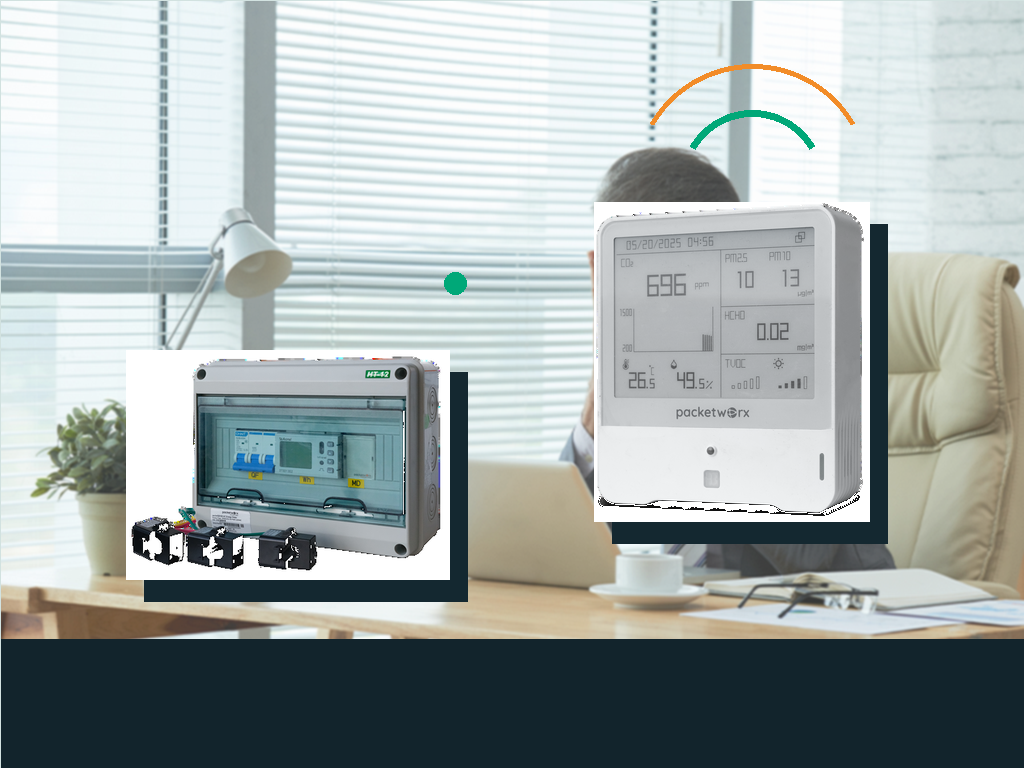
Smart Buildings: Deployment and Solution Perspective
A building-intelligence program identifies the operating conditions that matter, connects the right sensor points, and converts facility signals into response, reporting, and long-term performance improvement.
Executive Brief
- Focus area: Facilities and building operations.
- Connectivity model: low-power distributed sensing over LoRaWAN, supported by gateways, device management, dashboards, alerts, and integration-ready data.
- Solution fit: combine connectivity, packetSENSE devices, packetCELL gateways, packetVIEW, and partner enablement into a phased deployment.
- Implementation principle: start with measurable operational decisions, not with isolated devices.
The Property Operations and Tenant-Experience Problem
Smart building programs succeed when they improve day-to-day property operations: lower energy waste, better comfort, faster issue resolution, and clearer service accountability. Property teams need a connected view of building systems and occupant-facing spaces, not isolated devices that only produce unread data.
of global final energy consumption comes from building operations
IEA / GlobalABCof electricity consumption in buildings is linked to operations that can be influenced by controls, behavior, and maintenance
IEA Buildingshigher cognitive scores were observed in green and enhanced-ventilation building conditions versus conventional conditions
Harvard / PubMedPriority Use Cases
- Track air quality, comfort, and occupancy in tenant spaces, meeting rooms, lobbies, and shared amenities.
- Measure energy by area or system using AC energy meters and packetMODBUS to support sustainability and billing discussions.
- Use feedback buttons, leak sensors, smoke sensors, and door sensors to shorten the path from occupant issue to facilities action.
Building IoT Context
Buildings are dense operating environments. Air quality, occupancy, energy use, water leaks, access events, and equipment health change continuously, but many teams still discover issues through complaints, manual rounds, or monthly utility reports. LoRaWAN is useful in this setting because it supports low-power sensors across floors, rooms, risers, utility spaces, and distributed campuses without forcing every device onto Wi-Fi.
Reference Architecture
- Sensing layer: low-power devices capture physical signals such as air quality, water level, rainfall, energy, motion, temperature, humidity, equipment status, location, or user feedback.
- Connectivity layer: LoRaWAN carries small telemetry messages over long distances to packetCELL gateways or compatible LoRaWAN infrastructure, with cellular or wired backhaul where needed.
- Network and platform layer: the LoRaWAN Network Server, packetVIEW, and partner platforms manage device identity, payload decoding, dashboards, alerts, reports, and APIs.
- Operations layer: facility teams, LGUs, campuses, integrators, or enterprise users act on exceptions, compare trends, and refine thresholds based on actual field behavior.
Packetworx Solution Stack
This use case can be implemented as a layered solution rather than a one-off installation. Relevant Packetworx building blocks include:
- packetSENSE Indoor Air Quality for CO2, particulate matter, temperature, humidity, VOC, and comfort monitoring
- packetSENSE Leak Detection for tanks, pantries, restrooms, server rooms, HVAC drains, and utility spaces
- packetSENSE AC Energy Meter with packetMODBUS for electrical consumption and power-quality visibility
- packetSENSE PIR Motion Sensor and Indoor Temperature and Humidity with PIR for occupancy-aware facility operations
- packetSENSE Smoke, Smart Door Lock, Feedback Button, and SubZero for safety, access, service, and cold-chain rooms
Deployment Blueprint
- Define the operating decision first: alerting, reporting, compliance evidence, maintenance triage, resource optimization, or public-service coordination.
- Map the physical environment: sensor locations, mounting constraints, gateway placement, backhaul, power source, and field-service access.
- Select the sensing and integration stack: LoRaWAN devices, packetCELL gateways, packetMODBUS where legacy equipment is involved, packetVIEW dashboards, and APIs where the data must feed an existing platform.
- Set data rules before rollout: sampling interval, alert thresholds, escalation owner, historical reporting cadence, and exception-handling workflow.
- Pilot in a bounded area, review data quality and user behavior, then expand by repeating the same deployment pattern across sites, departments, campuses, or LGU locations.
Operational Metrics to Track
A successful rollout should define success measures before devices are installed. Useful metrics for this topic include:
- air-quality threshold events
- energy consumption by site or zone
- water-leak response time
- occupancy by room or floor
- maintenance tickets avoided or shortened
Governance, Security, and Integration
LoRaWAN deployments should be treated as operational technology, not casual gadget projects. Device identity, gateway ownership, alert permissions, dashboard access, data retention, and API use must be clear before scale-up. For schools, LGUs, utilities, and enterprises, the same discipline also improves procurement: each phase can be tied to coverage, device count, operating owner, service-level expectation, and a measurable outcome.
Background Reading
Bringing you the digital age of property management
Packetworx's smart building solution with LoRaWAN enable property ownerss and building managers to improve their operations and energy efficiencies, optimize revenues, and enhance occupants’ experience. Get actionable insights from data real-time and anywhere.
Improves Occupant Comfort & Productivity
Using low power smart meters, sensors, and actuators, building managers and property administrators will get insights on usage patterns, power outage, leaks, and aging infrastructures which can then reduce operating expenses and save on consumption.
5 to 10 years of battery life
Send alerts on tampering
Utilities | Data Centers | Warehouse | Condominiums | Offices | Real Estate/Villages
packetAIR | packetAIR PM
IAQ (Indoor Air Quality) Monitoring
Our IAQ Monitoring solution helps building owners and managers protect building occupants from contaminants in the air. By monitoring air quality, humidity, carbon dioxide levels real-time, our solution is effective in reducing the transmission of airborne bacterial and viral infections including COVID-19.
Accurate, real-time indoor air quality devices
Volatile Organic Compound
Hospitals | Offices | Malls | Restaurants | Hotels
Occupancy Monitoring and People Counting
Monitoring occupancy and counting people will give you valuable insights on your building, enabling real-time management of the building from resource allocation to adjusting indoor temperatures to increase comfort.
Malls | Hotels | Offices | Restaurants
packetCOUNTER | packetMOTION
With our environmental quality solutions, you get data about your facility to increase comfort and productivity providing a better occupants’ experience.
Office | Warehouse | Hospitals | Malls | Convenience Stores | Restaurants | Hotels
packetTempreture | packetAIR | packetTEMP + VoC
Our solution makes everyone safer by providing alerts and reports on a wide range of issues from dangerous chemical detection, fire alarms, water, or gas leaks, to intrusion.