
The Key to a Stable, Data-Driven Economy? Smart Cities and Buildings Developed With LoRaWAN-Enabled Solutions: Deployment and Solution Perspective
A staged smart-city operating model combines public-space sensors, utility visibility, climate data, facility monitoring, and citizen-facing programs.
Executive Brief
- Focus area: Smart cities and digital public infrastructure.
- Connectivity model: low-power distributed sensing over LoRaWAN, supported by gateways, device management, dashboards, alerts, and integration-ready data.
- Solution fit: combine connectivity, packetSENSE devices, packetCELL gateways, packetVIEW, and partner enablement into a phased deployment.
- Implementation principle: start with measurable operational decisions, not with isolated devices.
The City Data-to-Decision Problem
Cities and large building portfolios can collect large amounts of data but still fail to improve decisions if signals are not connected to operating outcomes. Data-driven urban programs should focus on which department acts, what threshold triggers a response, and how readings influence energy, resilience, public space, utilities, and maintenance.
of global primary energy is consumed by cities
UN-Habitatof global final energy consumption comes from building operations
IEA / GlobalABCLoRaWAN networks support additional city and building use cases over time
LoRa AlliancePriority Use Cases
- Use common data models and dashboards across city departments, facilities, and public-service workflows.
- Connect building, utility, weather, flood, and environmental data so decisions are based on operating context.
- Plan phased deployments where each use case produces a measurable service or resilience outcome.
Smart City Context
A smart-city program succeeds when data improves daily services, not when sensors are deployed as isolated demonstrations. LoRaWAN supports city-scale sensing because it can cover wide areas, serve many low-power devices, and support use cases across water, flood, air quality, public buildings, markets, schools, traffic-adjacent assets, and environmental resilience.
Reference Architecture
- Sensing layer: low-power devices capture physical signals such as air quality, water level, rainfall, energy, motion, temperature, humidity, equipment status, location, or user feedback.
- Connectivity layer: LoRaWAN carries small telemetry messages over long distances to packetCELL gateways or compatible LoRaWAN infrastructure, with cellular or wired backhaul where needed.
- Network and platform layer: the LoRaWAN Network Server, packetVIEW, and partner platforms manage device identity, payload decoding, dashboards, alerts, reports, and APIs.
- Operations layer: facility teams, LGUs, campuses, integrators, or enterprise users act on exceptions, compare trends, and refine thresholds based on actual field behavior.
Packetworx Solution Stack
This use case can be implemented as a layered solution rather than a one-off installation. Relevant Packetworx building blocks include:
- packetCELL gateways and LoRaWAN coverage planning for city districts, campuses, and public facilities
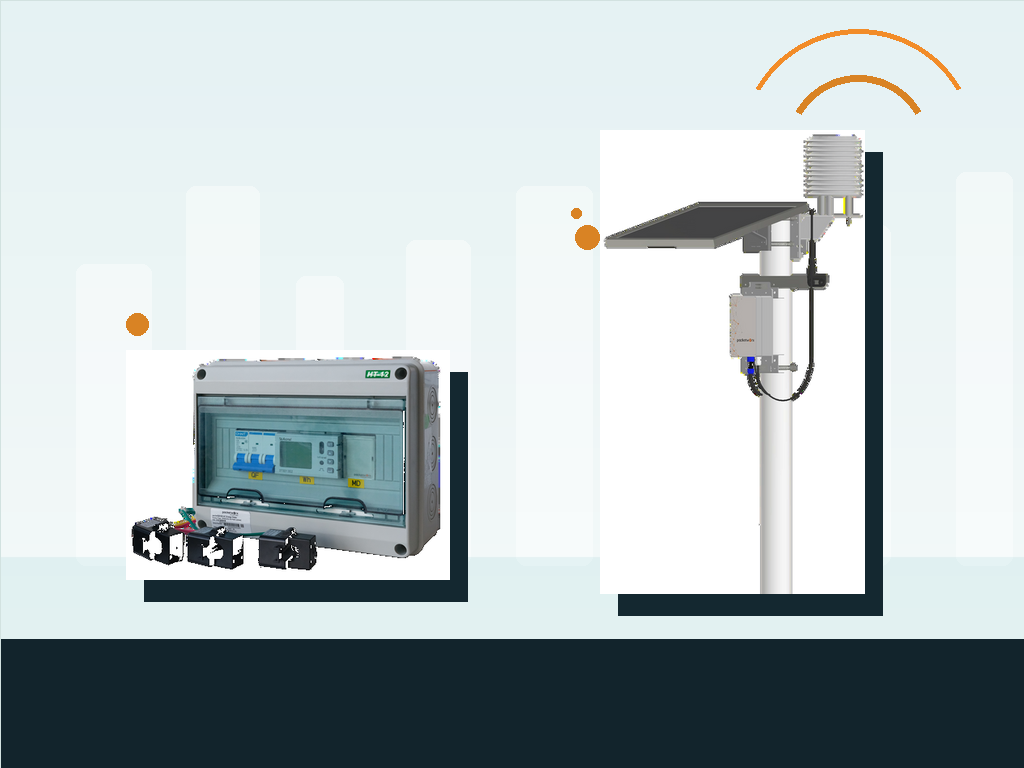
- Rainfall, water-level, air-quality, noise, weather, and utility sensors for public-space visibility
- Smart ultrasonic water meters, leak sensors, energy meters, and packetMODBUS for city infrastructure
- packetVIEW dashboards, alerts, reports, and API integration for operating teams
- Education, partner, and LGU enablement programs to move from pilot sites to repeatable city services
Deployment Blueprint
- Define the operating decision first: alerting, reporting, compliance evidence, maintenance triage, resource optimization, or public-service coordination.
- Map the physical environment: sensor locations, mounting constraints, gateway placement, backhaul, power source, and field-service access.
- Select the sensing and integration stack: LoRaWAN devices, packetCELL gateways, packetMODBUS where legacy equipment is involved, packetVIEW dashboards, and APIs where the data must feed an existing platform.
- Set data rules before rollout: sampling interval, alert thresholds, escalation owner, historical reporting cadence, and exception-handling workflow.
- Pilot in a bounded area, review data quality and user behavior, then expand by repeating the same deployment pattern across sites, departments, campuses, or LGU locations.
Operational Metrics to Track
A successful rollout should define success measures before devices are installed. Useful metrics for this topic include:
- coverage by district or facility
- public-service response time
- environmental threshold events
- utility loss or abnormal-use signals
- citizen or department reporting cadence
Governance, Security, and Integration
LoRaWAN deployments should be treated as operational technology, not casual gadget projects. Device identity, gateway ownership, alert permissions, dashboard access, data retention, and API use must be clear before scale-up. For schools, LGUs, utilities, and enterprises, the same discipline also improves procurement: each phase can be tied to coverage, device count, operating owner, service-level expectation, and a measurable outcome.
Background Reading
Packetworx, the leading IoT solutions provider in the Philippines, joined the 4th IoT Summit Philippines and iPV6 + 5G Global Summit. It happened last month at the SMX Convention Center Aura on September 18-19.
Packetworx joined the recently held 4th IoT Summit Philippines and iPV6 + 5G Global Summit held at SMX Convention Center.
The yearly convention gathers think tanks in the field of Internet of Things (IoT). Packetworx, as exhibitor, showcased products and solutions that create a more connected Philippines. These include Smart City and Smart Building solutions which use LoRaWAN technology. This complements iPV6 and 5G technologies. It will link us to better opportunities toward a digital future.
During the Summit, on-ground ambassadors of Packetorx discussed the different efforts focused on accelerating IoT adoption in the Philippines.
The possibilities for businesses, system integrators, and individual consumers are almost endless. Packetworx creates different workable solutions that can help ease these positive impacts. Packetworx speeds up the adoption of IoT through different dashboards, sensors, and solutions:
Effective Energy Management. With Packetworx's smart power meters, temperature, humidity, and ambient light sensors - city operations and facilities managers can easily monitor and eventually minimize energy usage. It also allows for a smarter allocation of resources within a facility.
Intelligent Climate Change and Flood Modeling. The extent of climate change is felt in more areas. This calls for more potent solutions when it comes to risk and disaster mitigation. With our battery-powered devices, cities can monitor remotely flood-prone areas and anticipate events - forecast of water level of flood-prone areas. This data can help cities to create essential risk-management solutions to reduce casualties and damages during a disaster. More importantly, its occurrence might be avoided because of how proactive the systems work.
Efficient Traffic Planning and Management. This is one among the long list of practical applications of IoT. Sensors installed on roads, streetlights, and other road-side infrastructure can lead to the creation of intelligent highways. Warning messages and diversion could be generated based on the data collected by these sensors, therefore the possibility of avoiding climate-related conditions such as flooding or other unexpected events like accidents or traffic jams.
Packetworx exhibit also featured its different products and solutions focused on building Smart Cities and Smart Buildings in the Philippines.
These solutions are possible because of LoRaWAN combined with iPV6 and 5G technology. They will contribute to building the structure that will establish Smart Cities. Packetworx also offers next-generation solutions that do more than automation. LoRaWAN can power an internet-connected ecosystem that does not need high bandwidth and expensive costs. Smart Buildings are ecological- and technologically-interlinked structures. These solutions by Packetworx have these advantages:
Access affordable analytics and reporting
Speed problem resolution
Improve occupant satisfaction
During the Summit, Packetworx Founder and CEO Arnold Bagabaldo actively participated in establishing linkages with IoT enthusiasts and attendees.