
Unlock Your Farm’s Full Potential with Smart Agriculture: Deployment and Solution Perspective
Climate and field intelligence becomes practical when field readings are connected to farm decisions, LGU resilience, water-resource planning, and risk reduction.
Executive Brief
- Focus area: Agriculture, weather, and environmental monitoring.
- Connectivity model: low-power distributed sensing over LoRaWAN, supported by gateways, device management, dashboards, alerts, and integration-ready data.
- Solution fit: combine connectivity, packetSENSE devices, packetCELL gateways, packetVIEW, and partner enablement into a phased deployment.
- Implementation principle: start with measurable operational decisions, not with isolated devices.
The Farm Decision-Timing Problem
Farms do not only need more readings; they need the right readings early enough to affect irrigation, crop protection, labor planning, and input use. Smart agriculture is strongest when soil, weather, water, and field-condition data are translated into decisions that improve productivity and reduce exposure to drought, excess rainfall, and resource waste.
of global freshwater withdrawals are used for agriculture, making irrigation efficiency a core operating issue
FAOtropical cyclones enter the Philippine Area of Responsibility on average
PAGASAof estimated Philippine disaster damage from 2010-2019 was borne by agriculture
World BankPriority Use Cases
- Use soil moisture, soil condition, rainfall, temperature, humidity, and weather data to guide irrigation and crop-protection timing.
- Monitor water sources, canals, ponds, and farm-adjacent drainage to understand field exposure before severe weather arrives.
- Create farm dashboards for cooperatives, estates, LGUs, and research groups that need localized evidence rather than broad regional averages.
Field and Climate Context
Philippine agriculture is exposed to highly variable rainfall, heat, wind, flooding, drought, and water-quality conditions. A resilient agriculture program needs more than periodic inspection; it needs distributed sensing that can stay in the field, operate on low power, and report conditions often enough to influence irrigation, planting, crop protection, aquaculture, and disaster-readiness decisions.
Reference Architecture
- Sensing layer: low-power devices capture physical signals such as air quality, water level, rainfall, energy, motion, temperature, humidity, equipment status, location, or user feedback.
- Connectivity layer: LoRaWAN carries small telemetry messages over long distances to packetCELL gateways or compatible LoRaWAN infrastructure, with cellular or wired backhaul where needed.
- Network and platform layer: the LoRaWAN Network Server, packetVIEW, and partner platforms manage device identity, payload decoding, dashboards, alerts, reports, and APIs.
- Operations layer: facility teams, LGUs, campuses, integrators, or enterprise users act on exceptions, compare trends, and refine thresholds based on actual field behavior.
Packetworx Solution Stack
This use case can be implemented as a layered solution rather than a one-off installation. Relevant Packetworx building blocks include:
- packetSENSE Automated Weather Station for wind, rainfall, radiation, pressure, temperature, and humidity context
- packetSENSE Rainfall and Submersible Hydrostatic Pressure Level for flood, watershed, and drainage monitoring
- packetSOIL and soil-moisture sensing for irrigation timing and crop-condition programs
- packetSENSE AquaMetrics Pro and AquaScope for water quality, aquaculture, reservoirs, and environmental programs
- packetSENSE Outdoor Air Quality with Solar Panel for climate, emissions, and public-environment monitoring
Deployment Blueprint
- Define the operating decision first: alerting, reporting, compliance evidence, maintenance triage, resource optimization, or public-service coordination.
- Map the physical environment: sensor locations, mounting constraints, gateway placement, backhaul, power source, and field-service access.
- Select the sensing and integration stack: LoRaWAN devices, packetCELL gateways, packetMODBUS where legacy equipment is involved, packetVIEW dashboards, and APIs where the data must feed an existing platform.
- Set data rules before rollout: sampling interval, alert thresholds, escalation owner, historical reporting cadence, and exception-handling workflow.
- Pilot in a bounded area, review data quality and user behavior, then expand by repeating the same deployment pattern across sites, departments, campuses, or LGU locations.
Operational Metrics to Track
A successful rollout should define success measures before devices are installed. Useful metrics for this topic include:
- rainfall intensity and accumulation
- soil moisture trend
- irrigation response time
- water quality exceptions
- localized weather anomalies
Governance, Security, and Integration
LoRaWAN deployments should be treated as operational technology, not casual gadget projects. Device identity, gateway ownership, alert permissions, dashboard access, data retention, and API use must be clear before scale-up. For schools, LGUs, utilities, and enterprises, the same discipline also improves procurement: each phase can be tied to coverage, device count, operating owner, service-level expectation, and a measurable outcome.
Background Reading
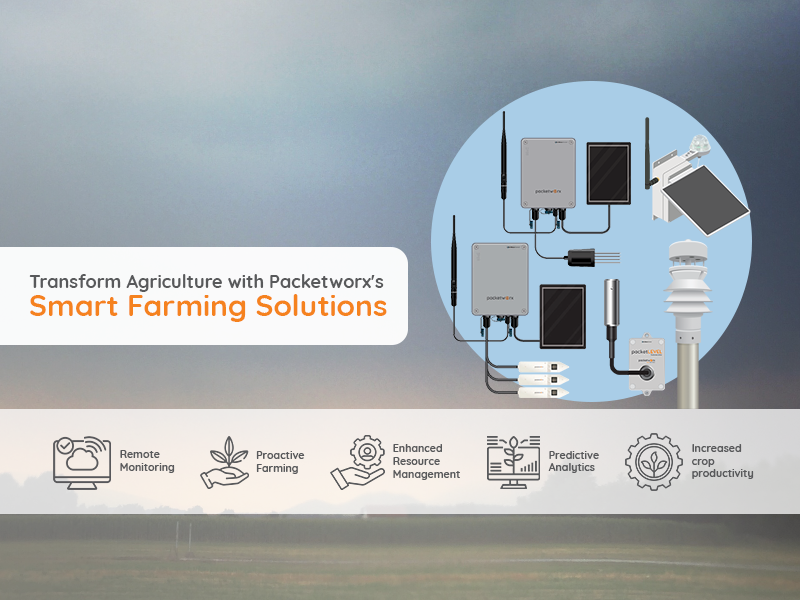
The Philippines’ geographical location makes it vulnerable to adverse weather conditions, such as typhoons and drought, impacting major sectors, particularly, agriculture. Packetworx, the leading IoT enabler in the country, is at the forefront of transforming agriculture through cutting-edge agriculture solutions. Our smart devices provide real-time monitoring and data collection, empowering farmers and agricultural operations.
Smart Agriculture Overview:
Proactive farming through real-time monitoring and uninterrupted data transmission
Remote monitoring of soil, weather, and crop conditions
Enhanced resource management by enabling data-driven decisions on irrigation, fertilization, and pest control
Predictive analytics to mitigate the effects of adverse weather
Increased crop productivity by providing a more efficient resource management
Smart Agriculture Devices
packetSENSE Soil Moisture - SLT5009: Combines three sensors into a single device to monitor soil moisture, temperature, and electrical conductivity, optimizing irrigation and crop management.
packetSENSE Soil NPK Sensor: Monitors critical soil parameters including moisture, temperature, pH levels, and nutrient content (Nitrogen (N), Phosphorus (P), and Potassium (K), commonly referred to as NPK), improving overall soil health and boosting crop yields.
packetSENSE Submersible Hydrostatic Pressure Sensor: Measures liquid pressure in various environments such as dams, rivers, and reservoirs, preventing potential floods and enhancing water management systems.
packetSENSE Rainfall Sensor: Provides real-time rainfall data, enabling early flood detection and water efficiency in farms. The dual functionality makes the sensor an invaluable tool for both disaster preparedness and agricultural practices.
packetWEATHER: Tracks weather parameters such as temperature and humidity, rainfall, wind speed, wind direction, air pressure, altitude, particulate matter, and radiation and delivers real-time data and early warning, mitigating the effects of natural disasters.
Monitoring soil conditions for precise irrigation and fertilization management
Optimizing water usage in agricultural fields
packetSENSE Soil NPK Sensor
Real-time monitoring of soil moisture, temperature, nutrient levels, and conditions for better soil quality and increased crop yields
Managing irrigation systems to optimize water usage
Controlling fertilizer applications to avoid wastage and ensure efficiency
Local Government Operations: Supports various municipal activities, from agriculture to infrastructure management.
Emergency Response: Enables swift and effective response protocols during adverse weather events.
packetSENSE Submersible Hydrostatic Pressure Sensor
Flood Monitoring & Prevention: Tracks water levels in rivers, reservoirs, and dams and issues early warnings, reducing flood risks.
Agricultural Irrigation: Helps optimize water levels in irrigation systems to prevent overwatering, helping farmers use water efficiently.