
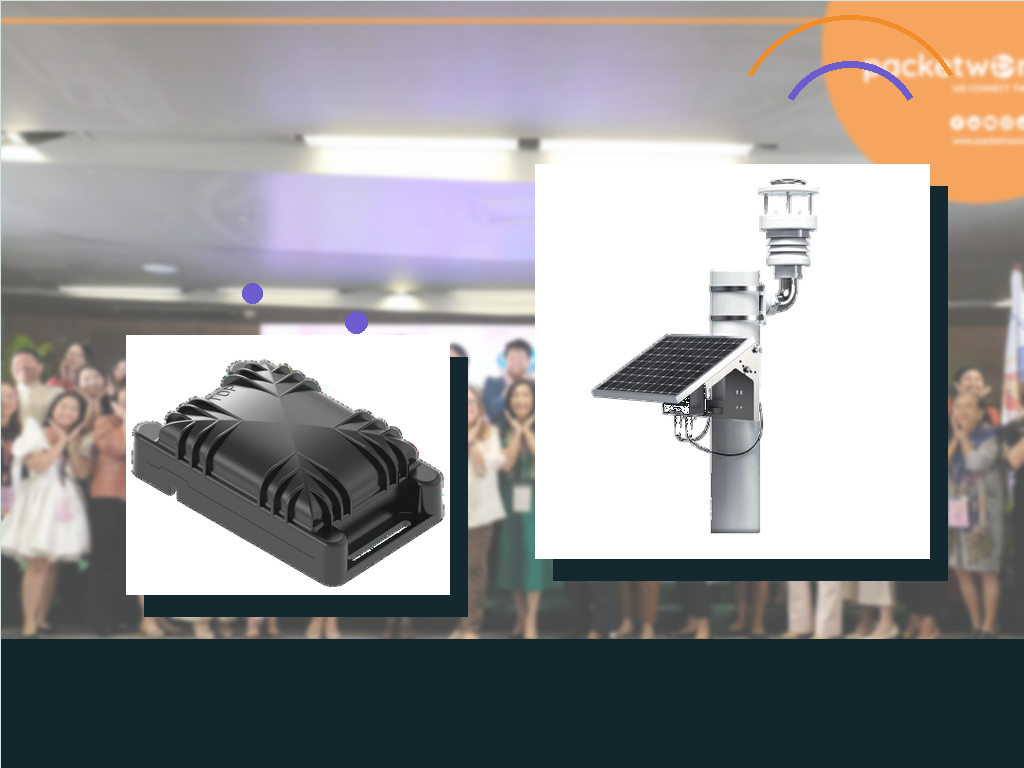
packetHACKS Finale: Celebrating the Champions of IoT Innovation: Deployment and Solution Perspective
IoT enablement depends on skills, partner readiness, student pathways, and a clear route from prototype to pilot deployment.
Executive Brief
- Focus area: Education, talent, and ecosystem enablement.
- Connectivity model: low-power distributed sensing over LoRaWAN, supported by gateways, device management, dashboards, alerts, and integration-ready data.
- Solution fit: combine connectivity, packetSENSE devices, packetCELL gateways, packetVIEW, and partner enablement into a phased deployment.
- Implementation principle: start with measurable operational decisions, not with isolated devices.
The Prototype-to-Pilot Problem
Hackathons create energy, but the real challenge is helping teams move from a compelling prototype to a deployable pilot. IoT innovation programs should test whether the use case has a real owner, a measurable outcome, workable sensor placement, reliable connectivity, and a path to support after the event.
packetHACKS x HackTheClimate 2025 participants were narrowed to 16 semi-finalist teams
IoT Conference Philippinessemi-finalist teams advanced in the packetHACKS x HackTheClimate 2025 program
IoT Conference PhilippinesIoT prototypes need field constraints, ownership, data rules, and maintenance planning before deployment
Packetworx packetHACKS articlePriority Use Cases
- Coach teams on problem framing, sensor selection, LoRaWAN coverage, dashboard design, and field constraints.
- Prioritize solutions around climate resilience, utilities, buildings, agriculture, logistics, and campus safety.
- Create a review path from demo to pilot, including site owner, deployment budget, alert workflow, and support plan.
Enablement Context
IoT adoption depends on people as much as devices. Schools, universities, system integrators, startups, LGUs, and enterprise teams need practical exposure to sensors, LoRaWAN coverage, dashboard design, data interpretation, and deployment discipline. Education programs, hackathons, internships, and developer kits turn abstract interest into working prototypes and deployable use cases.
Reference Architecture
- Sensing layer: low-power devices capture physical signals such as air quality, water level, rainfall, energy, motion, temperature, humidity, equipment status, location, or user feedback.
- Connectivity layer: LoRaWAN carries small telemetry messages over long distances to packetCELL gateways or compatible LoRaWAN infrastructure, with cellular or wired backhaul where needed.
- Network and platform layer: the LoRaWAN Network Server, packetVIEW, and partner platforms manage device identity, payload decoding, dashboards, alerts, reports, and APIs.
- Operations layer: facility teams, LGUs, campuses, integrators, or enterprise users act on exceptions, compare trends, and refine thresholds based on actual field behavior.
Packetworx Solution Stack
This use case can be implemented as a layered solution rather than a one-off installation. Relevant Packetworx building blocks include:
- packetduino, developer kits, and lab-ready devices for student and partner prototyping
- packetSENSE environmental, utility, occupancy, and tracker devices for hands-on use-case development
- packetCELL gateways and LoRaWAN network access for practical connectivity exercises
- packetVIEW dashboards for teaching data visualization, thresholds, alerts, and reporting
- Mentored programs such as Campus IoT Tour, IoT Technology Hub, internships, packetHACKS, and IoTCon activities
Deployment Blueprint
- Define the operating decision first: alerting, reporting, compliance evidence, maintenance triage, resource optimization, or public-service coordination.
- Map the physical environment: sensor locations, mounting constraints, gateway placement, backhaul, power source, and field-service access.
- Select the sensing and integration stack: LoRaWAN devices, packetCELL gateways, packetMODBUS where legacy equipment is involved, packetVIEW dashboards, and APIs where the data must feed an existing platform.
- Set data rules before rollout: sampling interval, alert thresholds, escalation owner, historical reporting cadence, and exception-handling workflow.
- Pilot in a bounded area, review data quality and user behavior, then expand by repeating the same deployment pattern across sites, departments, campuses, or LGU locations.
Operational Metrics to Track
A successful rollout should define success measures before devices are installed. Useful metrics for this topic include:
- number of trained students or partners
- working prototypes completed
- campus or LGU pilots launched
- mentor-review cycles
- projects moving from demo to deployment
Governance, Security, and Integration
LoRaWAN deployments should be treated as operational technology, not casual gadget projects. Device identity, gateway ownership, alert permissions, dashboard access, data retention, and API use must be clear before scale-up. For schools, LGUs, utilities, and enterprises, the same discipline also improves procurement: each phase can be tied to coverage, device count, operating owner, service-level expectation, and a measurable outcome.
Background Reading
Category winners and their innovative solutions
RISE - Smart Agriculture: Nurturing Crop Health and Efficiency
RISE leads the charge in agricultural innovation, with their Project Ani, offering a transformative solution via a user-friendly app. With features including Rice Identification models for disease and deficiency checks and Rice Classification models for variety and quality assessment, this app comes complete with a chatbot for queries and preventive measures. Farmers simply snap a photo of their crops through the seamless integration of IoT technology. The device then collects these images, generating data and results that empower farmers to make informed decisions, enhance crop health, and elevate agricultural productivity.
RISE is composed of Yuri Andre D. Custodio, Nathaniel Francis Alinio, and Pauline Angelee Young.
ArtemisPH - Smart Property: Empowering ESG Excellence
In a world increasingly focused on Environmental, Social, and Governance (ESG) responsibility, ArtemisPH steps in with an advanced cloud-based ESG management platform, Artemis.esg. Artemis uses machine learning and edge-enabled environmental trackers to assess vendor practices, compare performance, and generate comprehensive reports. Addressing ESG gaps, this solution aids stakeholders in making well-informed decisions, setting a pioneering benchmark for responsible property management.
ArtemisPH team is composed of Rey John D. Caballero, Eadrian M. Basila, Jurie Mae A. Castronuevo, Jay Mark B. Ugay, and Lance Philip M. Parungao.
BIMPS - Smart Logistics: Parking Redefined for Efficiency and Security
BIMPS transforms the parking landscape with an intelligent RFID-based system tailored for bicycles and motorcycles. Through secure locking, RFID card payments, and integrated CCTV monitoring, Bimps revolutionizes parking management. Simplicity, security, and user-centric design converge in this IoT solution, streamlining logistics and enhancing user experience in a rapidly evolving urban environment.
BIMPS team is composed of of Marwin Manalastas, Charles Joseph Adriano, Marco Ray Dalisay, and Angeline Vargas.
Liwad - Smart Utility: Revolutionizing Water Management with IoT
Liwad is at the forefront of water distribution management innovation, offering an affordable digitization and automation solution. Harnessing the power of IoT technology and a wireless data logger, Liwad seamlessly integrates information and communication technology. Sensor data is transmitted through the cloud for visualization, enabling swift issue resolution by maintenance crews. Liwad’s groundbreaking approach optimizes water distribution systems with unrivaled efficiency and precision.
Liwad team is composed of Engr. Rodolfo A. Jimenez Jr., Christopher P. Berin, and Aiza P. Hernandez.
J-Cube - Smart City: RFID-Driven Sustainability through Reverse Vending
J-cube introduces an ingenious Arduino-based reverse vending machine that redefines recycling. This visionary system identifies PET plastic bottles and aluminum cans, exchanging them for redeemable points via RFID technology. Supported by a user-friendly mobile app for point tracking and a web application for administrative oversight, J-cube’s solution encourages sustainability and elevates urban environments.
The champions of packetHACKS shine a spotlight on the boundless potential of IoT innovation. Through their ingenious solutions, which seamlessly merge cutting-edge technology with real-world necessities, they are helping reshape industries ranging from agriculture to property management and logistics. These breakthroughs underscore IoT’s pivotal role in instigating substantial transformation and igniting inspiration in countless Filipinos to push the frontiers of what can be achieved through IoT technology, creating a future-proof nation for all of us.
J-cube team is composed of John Lester Abaya, John Ashley Gime, and John Christopher Torcelino.
packetHACKS is a national competition headed by Packetworx, the first and only public LoRaWAN wireless connectivity provider for the Internet of Things (IoT) in the Philippines. packetHACKS aims to inspire creativity and innovation geared toward improving the lives of Filipinos.