
Packetworx Maximizes Digital Channels for Knowledge Sharing: Deployment and Solution Perspective
The technical value of LoRaWAN is strongest when it is combined with coverage strategy, device interoperability, partner enablement, hosted platforms, and repeatable deployment patterns.
Executive Brief
- Focus area: LoRaWAN network, partnerships, and IoT market adoption.
- Connectivity model: low-power distributed sensing over LoRaWAN, supported by gateways, device management, dashboards, alerts, and integration-ready data.
- Solution fit: combine connectivity, packetSENSE devices, packetCELL gateways, packetVIEW, and partner enablement into a phased deployment.
- Implementation principle: start with measurable operational decisions, not with isolated devices.
The IoT Knowledge-Transfer Problem
Digital channels can accelerate IoT adoption when they make complex concepts practical: what LoRaWAN is, where it fits, how deployments work, and what problems connected sensors can solve. Knowledge-sharing efforts should reduce confusion and help customers, partners, and students move toward informed pilots.
educational partners are highlighted in Packetworx community materials
Packetworx Community InitiativesLoRaWAN use cases span cities, buildings, utilities, agriculture, logistics, and industry
LoRa AllianceIoT education improves when content is tied to devices, dashboards, and local deployment examples
Packetworx knowledge-sharing articlePriority Use Cases
- Publish practical explainers for LoRaWAN, device selection, dashboards, coverage, and deployment planning.
- Use webinars, articles, events, and campus sessions to connect awareness with actual solution pathways.
- Help customers and partners distinguish between prototypes, pilots, and production deployments.
LoRaWAN Adoption Context
LoRaWAN fits IoT workloads that need long range, low power, wide-area coverage, and modest payloads from many distributed sensors. For the Philippine market, the strategic issue is not simply whether sensors can transmit; it is whether enterprises, LGUs, schools, telcos, and integrators can build reliable programs on top of connectivity, gateways, device management, dashboards, and support.
Reference Architecture
- Sensing layer: low-power devices capture physical signals such as air quality, water level, rainfall, energy, motion, temperature, humidity, equipment status, location, or user feedback.
- Connectivity layer: LoRaWAN carries small telemetry messages over long distances to packetCELL gateways or compatible LoRaWAN infrastructure, with cellular or wired backhaul where needed.
- Network and platform layer: the LoRaWAN Network Server, packetVIEW, and partner platforms manage device identity, payload decoding, dashboards, alerts, reports, and APIs.
- Operations layer: facility teams, LGUs, campuses, integrators, or enterprise users act on exceptions, compare trends, and refine thresholds based on actual field behavior.
Packetworx Solution Stack
This use case can be implemented as a layered solution rather than a one-off installation. Relevant Packetworx building blocks include:
- packetCELL Outdoor LoRaWAN Gateway for field, campus, city, and industrial coverage
- LoRaWAN Network Server and packetVIEW for device onboarding, routing, dashboards, and alerts
- packetMODBUS for connecting industrial and utility equipment that already speaks Modbus
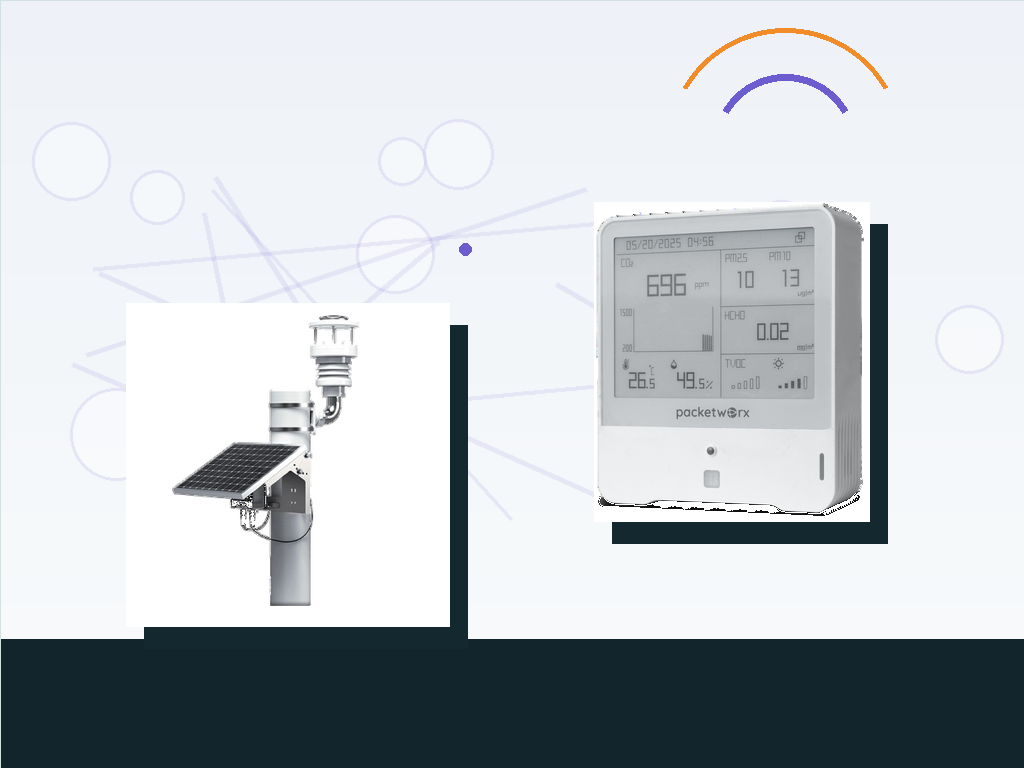
- packetSENSE devices across air quality, weather, water, power, motion, tracking, and safety use cases
- Partner integrations through REST APIs, system integrators, telcos, universities, and solution providers
Deployment Blueprint
- Define the operating decision first: alerting, reporting, compliance evidence, maintenance triage, resource optimization, or public-service coordination.
- Map the physical environment: sensor locations, mounting constraints, gateway placement, backhaul, power source, and field-service access.
- Select the sensing and integration stack: LoRaWAN devices, packetCELL gateways, packetMODBUS where legacy equipment is involved, packetVIEW dashboards, and APIs where the data must feed an existing platform.
- Set data rules before rollout: sampling interval, alert thresholds, escalation owner, historical reporting cadence, and exception-handling workflow.
- Pilot in a bounded area, review data quality and user behavior, then expand by repeating the same deployment pattern across sites, departments, campuses, or LGU locations.
Operational Metrics to Track
A successful rollout should define success measures before devices are installed. Useful metrics for this topic include:
- gateway availability
- device join success
- message delivery consistency
- battery replacement interval
- pilot-to-rollout conversion
Governance, Security, and Integration
LoRaWAN deployments should be treated as operational technology, not casual gadget projects. Device identity, gateway ownership, alert permissions, dashboard access, data retention, and API use must be clear before scale-up. For schools, LGUs, utilities, and enterprises, the same discipline also improves procurement: each phase can be tied to coverage, device count, operating owner, service-level expectation, and a measurable outcome.
Background Reading
Packetworx's Online Tech Learning offers free webinars that cover various IoT and tech-related topics, most of which are essential in coping with the new normal. Interest in IoT increases during the quarantineNationwide quarantine measures led businesses in the Philippines to explore digital channels for their continued services.
Because of this, interest in IoT grew in the past couple of months. Meanwhile, Packetworx's online learning sessions give stakeholders essential information about various IoT topics that can help them adapt with the new normal
The role of Packetworx in business
‘Since the quarantine started last March, Packetworx has focused on getting its devices to the market. These devices help enterprises cope better with the quarantine by enabling them to remotely monitor facilities. With record implementation timeline, we were able to deploy technologies that aid businesses in a highly cost-effective manner,’ said Arnold Bagabaldo, the social enterprise’s Founder and CEO.
He added that Packetworx is also increasing its efforts to educate people on the uses of IoT. ‘Together with community stakeholders, we are aiming to lessen the impact of the new norm to their daily lives and beyond that, lower cost, increase productivity, and allow enterprises to offer new products and services,’ Bagabaldo added.
Webinars as a learning tool
One of these efforts include gathering experts in subject areas that prove to be useful in the new normal. Through webinars, Packetworx wants to connect to stakeholders. It provides knowledge that is essential to continued learning despite the pandemic. According to their CEO, Packetworx is capitalizing digital channels that are easily-accessible and familiar to their stakeholders.
These webinars cover topics such as Data Visualization and IoT Platforms (Episode 1), LoRaWAN and IoT Use Cases for the New Normal (Episode 2), and Smart Cities’ solutions to adapt to the new world (Episode 3). Each episode’s guest speakers are think tanks from Packetworx's tech partners such as ThingsPH, Semtech Corporation, and Magnifi Machines.
Aside from its webinar series, Packetworx implements programs that assists the social enterprise’s beneficiary communities. It provide service and accessibility to communities who need it the most. This is why the group provides free LoRaWAN services and connectivity to communities for non-commercial IoT applications. These include farming technologies, humidity and temperature monitoring tools for at-risk communities. They also help academic institutions who receive free thesis consultations and capacity building activities. To date, Packetworx has conducted three webinar episodes. These are all available in one of its digital channels: Facebook https://www.facebook.com/packetworx/. Watch out for upcoming webinar episodes that cover different IoT solutions.